An IP code is two numbers: what the enclosure keeps out, and what water it resists. The wiring rules name the least code for a few places. This guide works three of them with the IP rating lookup. What each digit means is in IP ratings explained: each digit and letter.
An outdoor power point
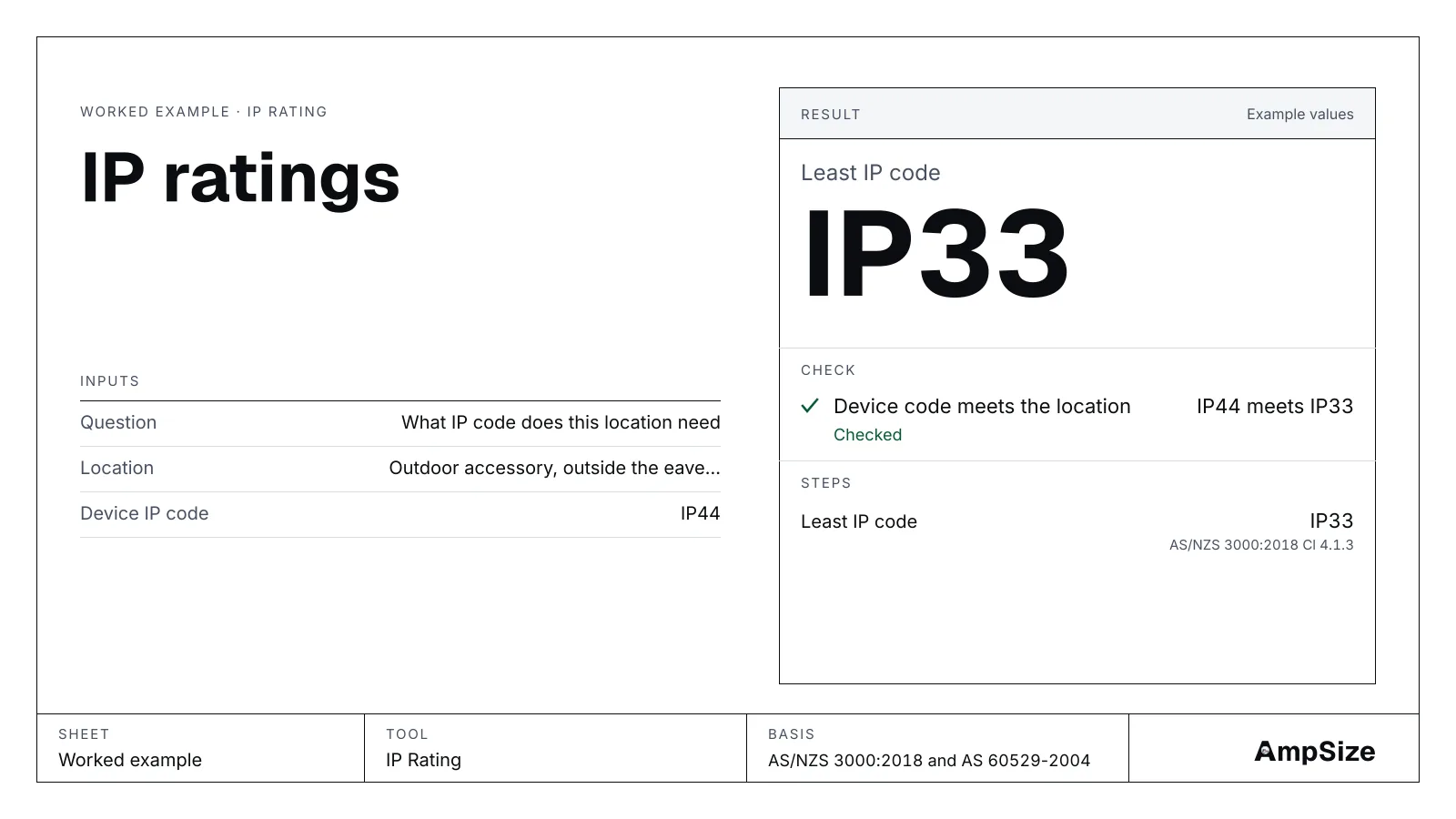
A socket‑outlet on an outside wall. Under an eave or verandah, inside the area between the soffit edge and a line at 30 degrees back to the wall, an accessory needs no IP marking. Outside that area it needs at least IP33 (Cl 4.1.3).
Check an IP44 outlet. IP44 meets IP33: 4 is above 3 for objects, and splashing water is above spraying.
Check an IPX4 outlet. IPX4 is below IP33, because its first numeral is not stated. A code with an X makes no claim for that digit.
A milking shed hosed at high pressure
Where equipment is hosed down, the classified zone needs at least IPX5 for low or medium pressure and IPX6 for high pressure (Cl 6.7.4.1).
Check an IP67 light. IP67 is below IPX6. A second numeral of 7 is for temporary immersion, and AS 60529 does not count it as protection against water jets. A light rated for both is dual coded, such as IP66/IP67.
Check an IP66 light. IP66 meets IPX6.
The switchboard in the shed
A switchboard in a hosing-down zone needs at least IPX6 (Cl 2.10.2.5(g)). Open the switchboard. The same rule sits in Cl 6.7.4.3.
The result
| Place | Least code | IP44 | IP66 | IP67 |
|---|---|---|---|---|
| Outdoor accessory, outside the eave area | IP33 | Meets | Meets | Meets |
| Hosed area, high pressure | IPX6 | Below | Meets | Below |
| Switchboard in a hosed zone | IPX6 | Below | Meets | Below |
A bathroom, laundry, pool or spa is different: the code depends on the zone. Use the wet area zones tool for those.