A new kitchen and an outdoor barbecue area put power points and switches close to heat, gas and water. AS/NZS 3000 keeps them out of set zones around each. This guide checks each position with the accessory location checker. The rules are explained in Power points near a cooktop, gas bottle and sink.
Step 1. The power point beside the cooktop
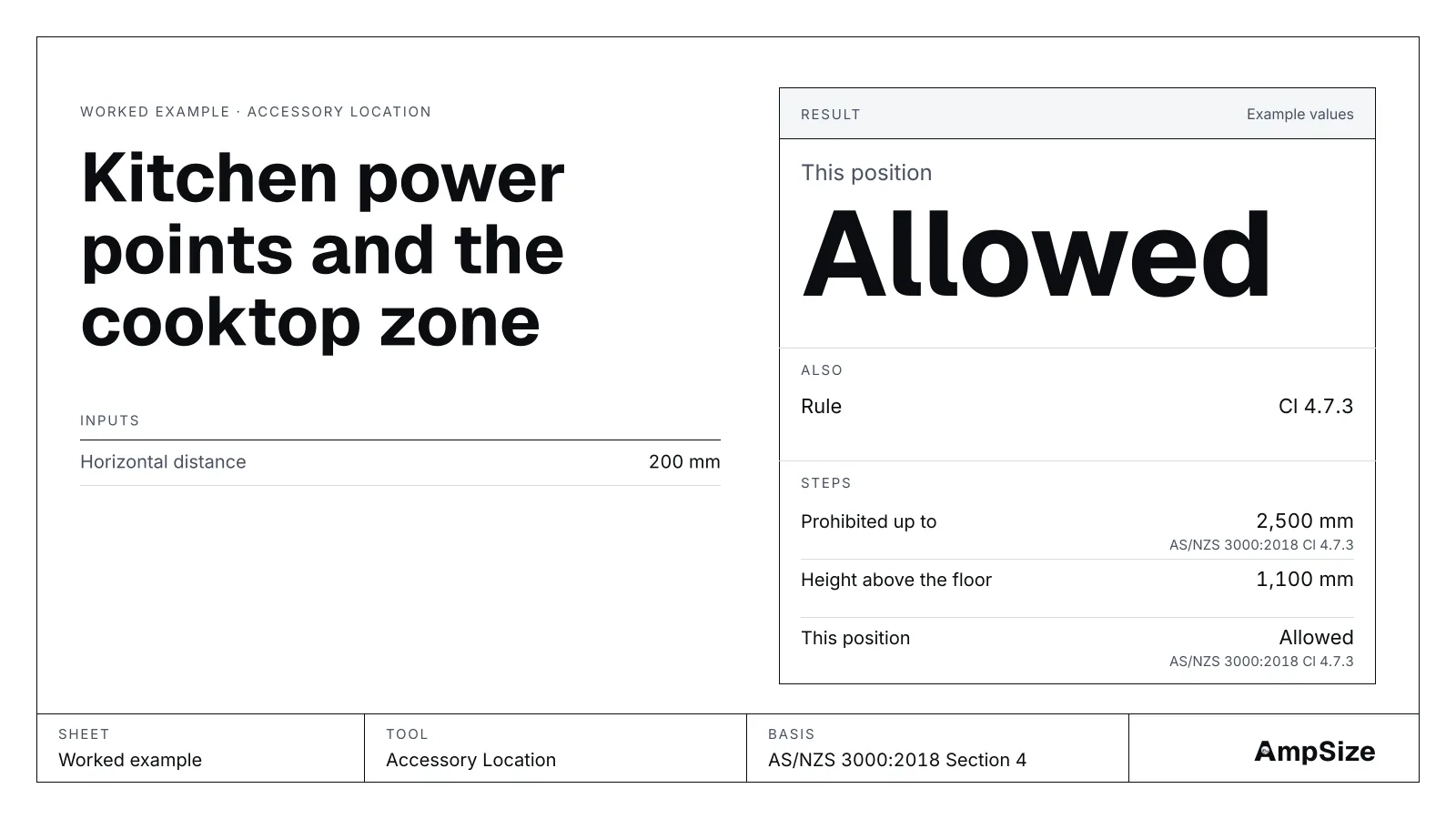
A power point must not sit within 150 mm of the edge of an open cooking surface, from the cooking surface up (Cl 4.7.3, Figure 4.17). The zone covers walls, cupboards and any other surface.
| Power point | From the cooktop edge | Result |
|---|---|---|
| On the splashback, 1100 mm up | 100 mm | Not allowed |
| On the splashback, 1100 mm up | 200 mm | Allowed |
Open the power point at 100 mm. Open it at 200 mm.
Step 2. How high the zone goes
The zone runs from the top of the cooking surface up to a range hood or cupboard above it, or to 2500 mm above the floor below the cooktop, whichever is lower.
- With no range hood, the zone reaches 2500 mm. A power point 100 mm from the edge at 2600 mm is above it and allowed.
- Under a range hood at 1800 mm, the zone stops at 1800 mm. A power point 100 mm from the edge at 1900 mm is allowed. Open it above the range hood.
Step 3. The cooktop switch
A cooktop needs its own switch (Cl 4.7.1). The rules for where it goes:
- near the cooktop, where it can be seen and reached easily;
- not on the cooktop itself;
- not where the user must reach across the cooking surface;
- outside the 150 mm zone, like any switch (Cl 4.7.3).
A switch 600 mm from the edge is allowed. The same switch is not allowed if you must reach across the cooktop to use it. Open the switch reached across.
The clause also advises a switch within 2000 mm of the cooktop. That is advice in a note, so the tool reports it and does not fail a switch further away.
Step 4. The power point by the gas bottle
Outdoors, a heavier-than-air gas cylinder has a hazardous area around it (Cl 4.18.2.1, Figure 4.18). No power point, switch, light, switchboard or air conditioner may sit in it. The figure gives two widths from the cylinder centre line: B at the base and A at the top, 0.5 m above the valve.
| Cylinder | A, at the top | B, at the base |
|---|---|---|
| Exchange | 500 mm | 1500 mm |
| In-situ fill | 1500 mm | 3500 mm |
Between A and B the tool takes the edge of the area as a straight line, as the figure draws it. That is the tool's reading of the drawing. Measure on site where the result is close.
For an exchange cylinder 1300 mm high, the area reaches 1800 mm above the ground.
- A power point 1200 mm from the centre line at 300 mm up is inside: the area reaches 1333 mm there. Not allowed. Open it.
- Raise it to 1500 mm and the area reaches only 667 mm at that height. Allowed. Open it raised.
- At 1600 mm out and 300 mm up, it is outside an exchange cylinder's area, but inside an in-situ fill cylinder's, which reaches 3167 mm there. Open the in-situ fill case.
Step 5. The gas relief vent
A gas relief vent has an exclusion zone (Cl 4.18.4, Figure 4.19). For a vent up to 50 mm across it is 1500 mm long in the discharge direction and 1000 mm across, with a 500 mm radius behind the vent. A larger vent scales the zone by T, its diameter over 50. A light 1000 mm in front of a 20 mm vent is inside the zone and not allowed. Open the light by the vent.
Step 6. The power point by the sink
AS/NZS 3000 sets the zones around a sink, basin, bath or shower in Section 6. The accessory checker hands this case to the wet area zones tool, which checks the zone, the IP rating and the RCD.
New Zealand only
In New Zealand, an indoor compartment for a gas cylinder may hold no power point, switch or other equipment that can ignite gas (Cl 4.18.3). In a New Zealand home, only equipment that serves the gas supply may go in the area around an outdoor cylinder (Cl 4.18.2.3). Around a reticulated natural gas regulator, a zone of 800 mm radius about the riser and 1600 mm high is kept clear (Cl 4.18.5, Figure 4.20).
What AS/NZS 3000 does not set
AS/NZS 3000 prints no general height for power points or switches above a bench or a floor. Near the floor it asks only that a power point within 75 mm of the floor takes its plug out sideways (Cl 4.4.2.2(b)). Heights for access are set by building codes and the client, not by this standard.
The result
| Position | Result |
|---|---|
| Power point 200 mm from the cooktop edge | Allowed |
| Cooktop switch 600 mm away, not reached across | Allowed |
| Power point 1200 mm from an exchange cylinder, 1500 mm up | Allowed |
| Light 1000 mm in front of a gas vent | Not allowed |