A commercial fit-out in Australia needs one riser conduit to a sub‑board. The conduit carries four three‑phase feeders and a control group. The first idea is 50 mm conduit. This guide checks that idea against the fill rule.
The inputs
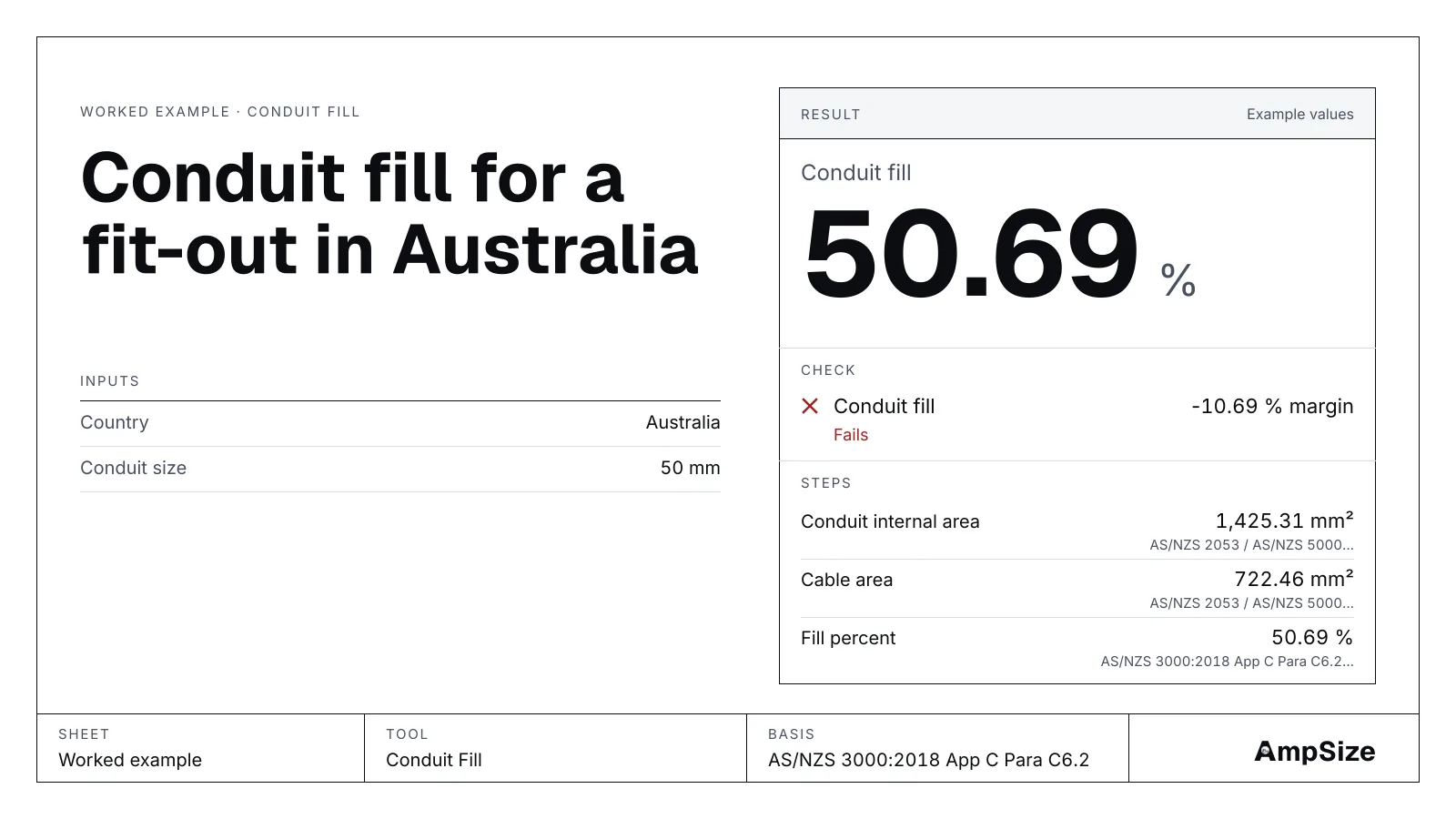
- Australia, 50 mm conduit.
- Six 35 mm² single‑core cables. These are the actives of two three‑phase feeders.
- Six 16 mm² single‑core cables. These are the actives of two more feeders.
- Four 6 mm² single‑core cables for a control group.
AS/NZS 3000:2018 App C Para C6.2 gives the space factors. The tool compares the cable area with the internal area of the conduit. For this cable count the tool permits a fill of 40 %.
The steps
Open the run. The 16 cables occupy 722.46 mm². The 50 mm conduit has an internal area of 1,425.31 mm². The fill is 50.69 %. That fails the 40 % limit.
The tool recommends 63 mm conduit.
Move up a size
63 mm conduit has an internal area of 2,332.83 mm². The fill is 30.97 %, with 9.03 % to spare. The run passes.
80 mm conduit has an internal area of 4,901.67 mm². The fill is 14.74 %.
Fit-outs change. Add four more 6 mm² cables for a late request and 63 mm conduit fills to 34.47 %. It still passes, but the spare room has gone.
Why the country matters
The tool carries a country select. New Zealand and Australian conduit differ in bore at the larger sizes. Take the same cables in 80 mm conduit under New Zealand rules. The fill is 15.88 %. Australian 80 mm conduit gives 14.74 %. Do not copy a New Zealand table for an Australian job.
What the tool does not do
AS/NZS 3000 Appendix C also tabulates a maximum cable count in Tables C10 to C12. The tool uses the fill percentage method. Check the count tables when the inspector asks for them.
Fill is only one limit. Cables in one conduit also derate. Run the cable size calculator with the number of grouped circuits, because grouping can force a larger conductor.
What the fill figure covers
Fill compares the cable area with the conduit area. It does not cover the pull. A conduit that fits by area can still be hard to pull. Many bends or a long run make it worse. Add a draw-in box at the bends, and pull the cables together where the layout allows it.
Single‑core cables of one circuit should share one conduit. The magnetic fields of a three‑phase group then cancel. A group split across steel conduits can heat the steel. Keep each circuit's cables together.
Record the conduit size and the fill in the schedule. The next fit-out then starts from a known figure.
Choosing the conduit
Pick the conduit for the final cable count, not the first. A fit-out adds cables. Allow for the spare capacity the client wants. The late-request case above fills a 63 mm conduit to 34.47 %, short of the 40 % limit.
Compare the cost of 80 mm conduit with the cost of a second conduit later. A second conduit through a finished ceiling costs far more than the larger size now.
The result
| Conduit | Fill | Result |
|---|---|---|
| 50 mm | 50.69 % | Fails |
| 63 mm | 30.97 % | Passes |
| 80 mm | 14.74 % | Passes |
| 63 mm, four extra 6 mm² | 34.47 % | Passes |
The riser needs 63 mm conduit for 16 cables. Try it with these inputs.
This page is a design aid. Verify every value against the current edition of the standard.
See also: Conduit fill and installation methods, Conduit fill for PV string cables in 32 mm conduit and Correction factors in a hot roof space, 2025.