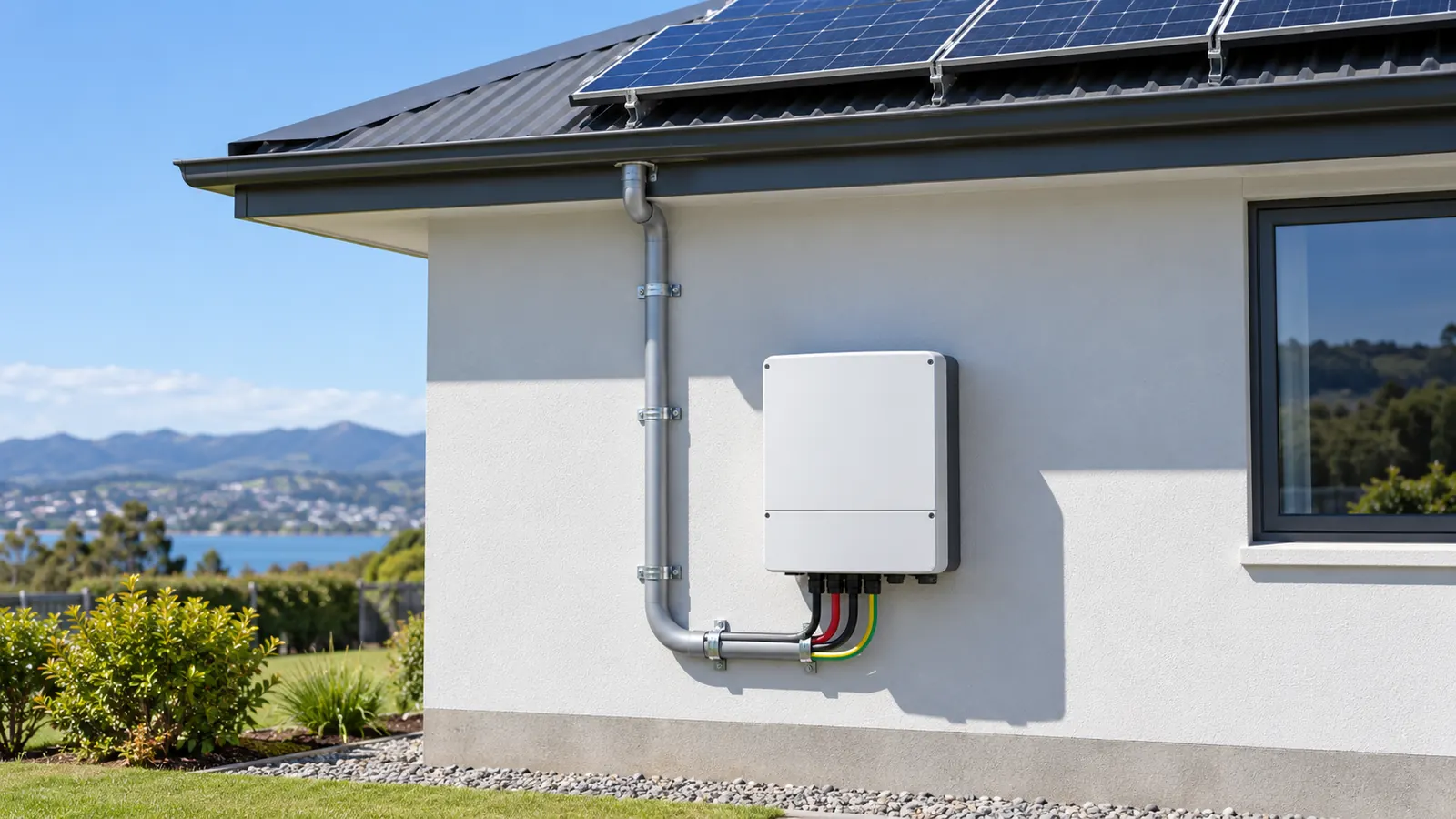
Three PV strings drop from a roof into one conduit. That is six single core cables, one positive and one negative per string. This page checks whether 32 mm conduit carries them.
The inputs
- Conduit size: 32 mm nominal
- Cables: 6 off 6 mm² single core
Single core matters here. A 6 mm² single and a 6 mm² two core have different overall diameters. The overall diameter sets the area. PV string cable is almost always single core.
The clause
AS/NZS 3000:2018 Appendix C Paragraph C6.2 gives the space factors. The tool uses 50 % for one cable, 33 % for two and 40 % for three or more. Six cables take the 40 % figure.
Tables C10 to C12 of the same Appendix give a maximum cable count instead of a percentage. The two methods do not always agree. The tool states which one it used with every result.
AS/NZS 3000:2018 Cl 7.3 covers electricity generation systems. That part adds rules for PV wiring on segregation, identification and isolation.
The steps
The tool works out the internal area of the conduit from the nominal size. It adds the overall area of each cable. It divides one by the other.
- Conduit internal area: 539.13 mm²
- Total cable area: 122.57 mm²
- Fill: 22.73 %
- Permitted fill: 40 %
The result
The fill is 22.73 % against a 40 % limit. The bundle passes with a wide margin.
The tool reports a recommended conduit of 32 mm, the size in the example. In a 25 mm conduit six 6 mm² singles give 40.62 %, just over the limit. Two more things argue for 32 mm.
The first is draw in force. A long roof to inverter run with several bends gets harder to pull as the fill rises. The fill percentage does not model bends or pulling tension.
The second is future strings. A 32 mm conduit leaves room for a fourth string without a second run. On a roof, adding a conduit later costs more than oversizing it once.
Overall diameters come from manufacturer data and vary by brand. Double insulated PV cable is often thicker than a general purpose building wire of the same conductor size. Check the cable data sheet when the fill lands close to the limit.
Conduit fill does not check current rating. Cables bunched in a conduit in a hot roof space carry a grouping factor and a high ambient. Run the same cables through the cable size tool with the enclosed method before you settle the size.
Fill percent does not decide everything. Cl 7.3 and the PV standards govern whether DC string cables may share a conduit with other circuits. Check AS/NZS 5033:2021 for the separation rules that apply to a PV array, and confirm the edition that applies to the installation.
Adding a string changes the arithmetic quickly. Eight 6 mm² singles raise the cable area by a third. Run the new count through the tool rather than scaling the percent by eye.
This page is a design aid. Verify every value against the current edition of the standard.
See also: Conduit size for 35 mm cable in a submain, AS/NZS 3000 Appendix C: conduit space factor and Conduit fill and installation methods.