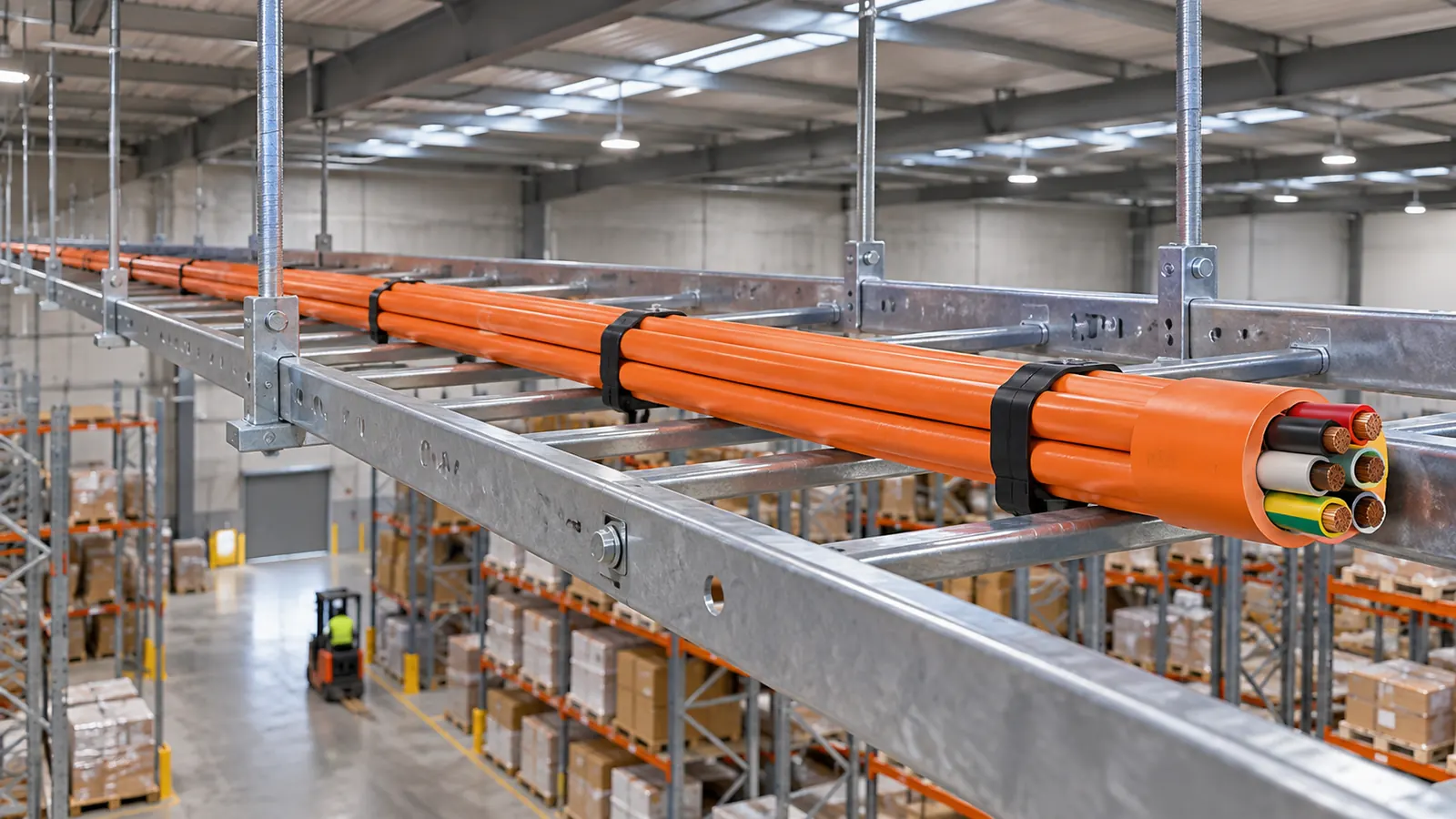
A tenancy submain leaves the main switchboard on a cable tray. The run is 60 m. The ceiling space reaches 40 degrees and a second submain shares the tray. Four checks decide the size, and only one of them sets it.
The question
The submain has to carry 100 A to a tenancy board 60 m away, on a shared tray, in a hot ceiling. The conductor that does it is not the smallest cable that carries the current.
The inputs
- Phases: 3, line voltage 400 V
- Load current: 100 A
- Route length: 60 m
- Install method: unenclosed, touching
- Ambient temperature: 40 °C
- Grouped circuits: 2
- Insulation: XLPE
- Device: 100 A, curve C
- External loop impedance Ze: 0.2 Ω
The clauses and the tables
Cl 3.4 of AS/NZS 3000:2018 sets the current carrying capacity check. Cl 3.6.2 sets the voltage drop limit. Cl 5.7.4 sets the loop impedance check. Table 14 of AS/NZS 3008.1.2:2017 holds the tabulated ratings for this install method. Tables 22 to 26 hold the grouping factors and Tables 27(1) and 27(2) hold the ambient factors.
The steps
The tool derates first, then selects.
- Ambient factor at 40 °C: 0.91
- Grouping factor for 2 circuits: 0.8
- Soil factor: 1
- Burial depth factor: 1
- Total derating factor: 0.728
Dividing 100 A by 0.728 gives a required tabulated current of 137.36 A. That is the rating the conductor must show in Table 14 before any derating.
Then the tool walks the sizes and applies every check to each one.
- 25 mm² derates to 88.82 A. It fails the current check.
- 35 mm² derates to 109.93 A and drops 1.65 %. It passes current, drop and device, and gives a Zs of 0.38 Ω. It fails the loop impedance check.
- 50 mm² derates to 134.68 A and gives a Zs of 0.32 Ω. It still fails the loop impedance check.
- 70 mm² derates to 170.35 A, drops 0.88 % and gives a Zs of 0.28 Ω. It passes every check.
The result
The tool returns 70 mm². The derated capacity is 170.35 A against a 100 A load and a 100 A device. The voltage drop is 0.88 %. The earth fault loop impedance is 0.28 Ω with a 25 mm² earth conductor. The tool reports a pass and no warnings.
The margin on capacity looks generous. It is not the reason for the size. The loop impedance check is what rejects 35 mm² and 50 mm². A 100 A curve C device needs a large fault current to operate in time. 60 m of conductor plus a 0.2 Ω external loop pushes the total too high on the smaller sizes. Raising the conductor area lowers R1 and R2 together, because the earth conductor grows with the active.
Two inputs move this result more than the others.
The Ze. 0.2 Ω is a value you get from the network operator or from a measurement. A higher Ze leaves less room in the loop and pushes the size up again.
The grouping. One circuit on the tray instead of two removes the 0.8 factor. The required tabulated current falls, although the loop impedance check does not change.
XLPE insulation raises the tabulated rating against PVC for the same conductor. It does not change the resistance, so it does not help the voltage drop or the loop impedance.
This page is a design aid. Verify every value against the current edition of the standard.
See also: Cable size for a 32 A single‑phase 25 m run, AS/NZS 3008.1.2 Tables 22 to 29: derating and Current-carrying capacity and derating.