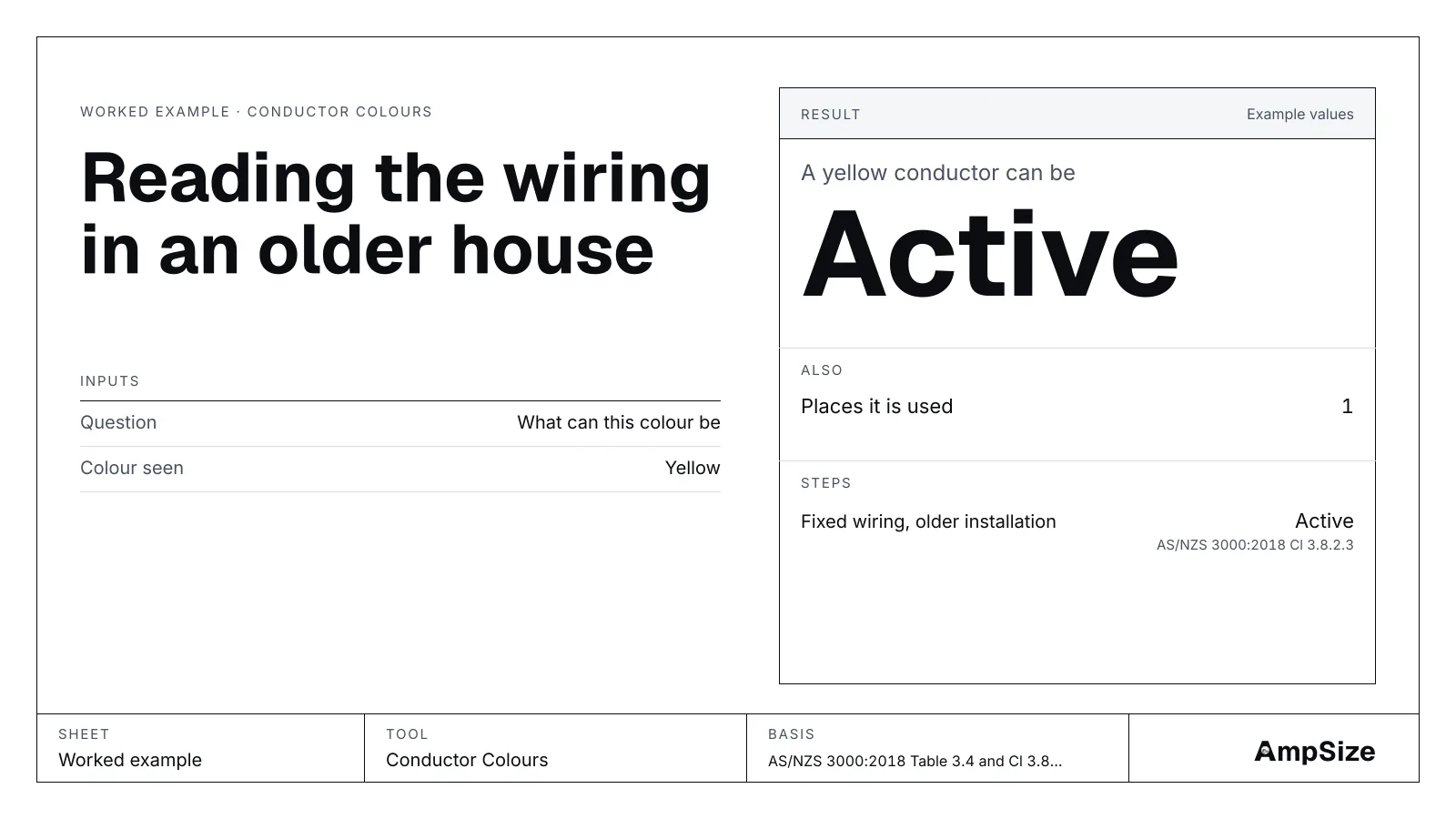
An older house can carry wiring colours that no new work uses. Before you add a circuit or change a fitting, read each conductor for what it can be, then prove it by test. This guide works through the colours found in an older New Zealand house with the conductor colour lookup. The current rules are in Wire colours in NZ and Australia, old and new.
What the house has
A lighting switch box with three conductors: red, yellow and green. At the board: black neutrals, a green main earth and red actives.
Step 1. The yellow conductor
Open yellow. Yellow can only be an active from an installation wired to a previous edition. It is never an active or a neutral in new work (Cl 3.8.1). In a two‑way switch loop it is often a strapper or a switched active.
It may stay. But when you make a new termination or junction on it, sleeve it white at that point (Cl 3.8.2.3). Treat it as live until a test says otherwise.
Step 2. The green conductor
Open green. Green is an earthing or bonding conductor from a previous edition, or the earth of a superseded flexible cord. A bare earth reads the same way. It may stay, but a new termination on it takes green/yellow sleeving (Cl 3.8.2.2).
Step 3. The black conductor
Open black. In fixed wiring black is the neutral, and in a New Zealand domestic installation it is the only neutral colour (Table 3.4 Note 4). But black is also the neutral of a superseded cord and a phase of a modern three‑phase cord. On fixed wiring in a house, expect a neutral, and test it.
Step 4. New work beside the old
Open the older colours. New fixed wiring in a New Zealand home uses:
| Function | Colour |
|---|---|
| Active | Red or brown recommended; any colour but green, yellow, green/yellow, black or light blue |
| Neutral | Black |
| Protective earth and bonding | Green/yellow |
Do not mix these with European core colours in one enclosure or one multicore cable (Note 3).
Flexible cords in the house
An old appliance cord may be red, black and green. Modern cords are brown, light blue and green/yellow (AS/NZS 3760 Table C.1.1). An imported cord may follow neither, and its plug may have been replaced, so confirm the polarity before use. The test and tag tool covers the checks for a cord.
A colour says what a conductor should be. Before you work on it, prove it dead and prove what it is by test; the test results tool holds the limits for the readings.