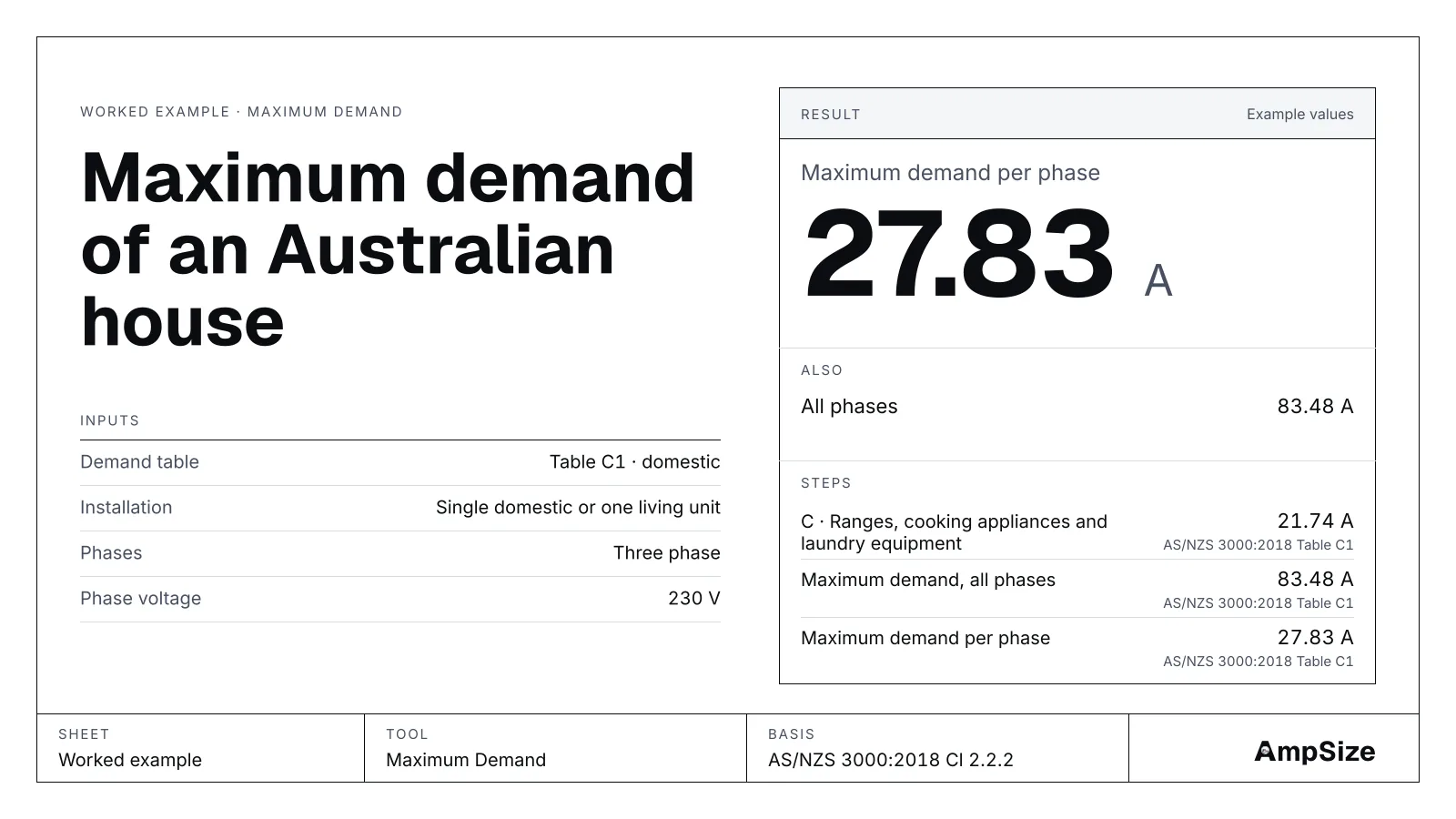
A new four-bedroom house in Australia has a three‑phase supply. The network wants the maximum demand, and the electrician needs it to size the consumer mains. Table C1 of AS/NZS 3000:2018 gives the assessment. It is not a sum of every rating.
The inputs
- Table C1, single domestic installation, three phase, 230 V per phase.
- A(i) lighting: 28 points.
- B(i) socket‑outlets and equipment up to 10 A: 36 points.
- C ranges, cooking and laundry: 10 kW.
- D fixed space heating and air-conditioning: 8 kW.
- F storage water heater: 3.6 kW.
AS/NZS 3000:2018 Cl 2.2.2 requires the assessment. Table C1 sets a rule for each group.
The rules by group
Table C1 treats groups in different ways. Lighting takes a first block of points at a set current. Each further block of 20 takes a smaller current. Sockets work the same way with larger currents. Cooking and laundry take a share of the kilowatt load. Heating and air-conditioning take another share. A storage water heater takes it in full.
The steps
Open the run. The tool returns one figure for each group:
- A(i) lighting: 5 A.
- B(i) sockets: 15 A.
- C cooking and laundry: 21.74 A.
- D heating and air-conditioning: 26.09 A.
- F storage water heater: 15.65 A.
The total across all phases is 83.48 A. The tool divides by three for the heaviest phase. The maximum demand is 27.83 A per phase.
The same house on one phase
A single‑phase supply carries the whole load. Switch the phases to 1 and the demand is 83.48 A. The three‑phase supply cuts the line current to a third.
From demand to the consumer mains
The demand is a design current. The consumer mains must carry it. Take 20 m of copper PVC cable in air at 40 °C on the 2025 edition. The three‑phase run needs 4 mm². The derated capacity is 29 A and the drop is 1.23 %.
The single‑phase run at 83.48 A needs 25 mm². The derated capacity is 91 A and the drop is 1.21 %.
The network operator sets its own service rules and minimum sizes. Check them before you order cable. The tool sizes on demand and heat only.
What the table leaves out
Table C1 has groups this house does not use. Group G covers spa and pool heaters. Group M covers other appliances and socket‑outlets over 5 A, and it asks for an assessment. Group J(iv) covers communal charging equipment for electric vehicles.
A single house charger is a separate check. See the EV charger circuit in a Victorian garage. The learn page on maximum demand by measurement and limitation covers the measured route.
Using the figure
The per-phase figure is a design current for the consumer mains. It is also the number the network operator asks for in a supply application. State the table and the groups you used, so a reviewer can repeat the assessment.
Check the rules for diversity. A load that is present in the house but is not on the list will not appear in the total. Walk the house and list every fixed appliance before you enter the groups. A missing group lowers the figure, and a lower figure is the wrong kind of error.
Re-run the assessment when the house changes. A heat pump, a pool or a second oven changes the groups. Keep the assessment with the job file, and date it.
The result
| Case | Demand | Consumer mains on 2025 |
|---|---|---|
| Three phase, per phase | 27.83 A | 4 mm², 29 A |
| One phase | 83.48 A | 25 mm², 91 A |
The house assesses at 27.83 A per phase. Group D is the largest line, at 26.09 A. Try it with these inputs.
This page is a design aid. Verify every value against the current edition of the standard.
See also: Domestic maximum demand with Table C1, Maximum demand per phase on a three‑phase supply and EV charger circuit in a Victorian garage.