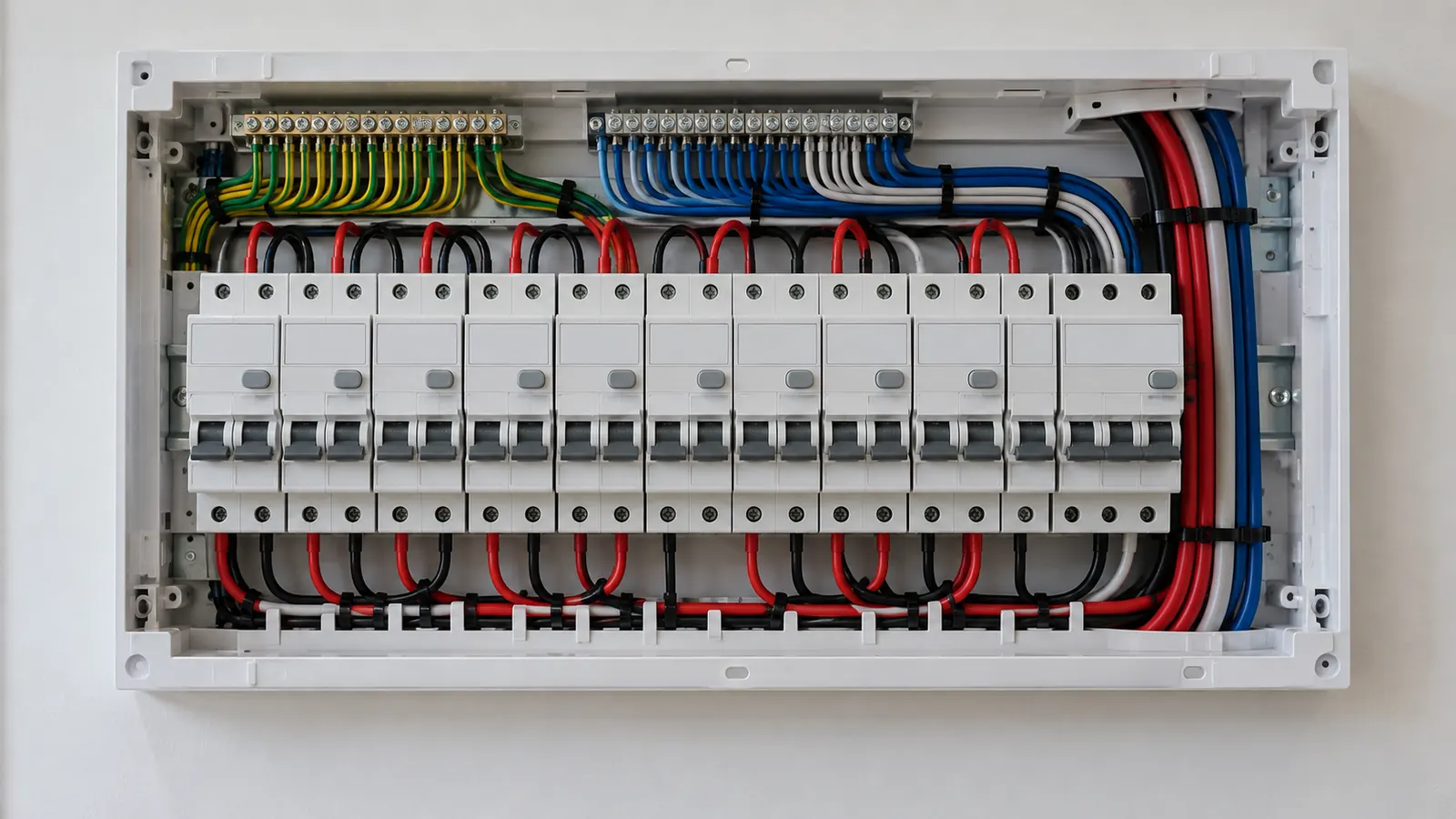
A circuit breaker watches one conductor. A residual current device watches the balance between conductors. That difference is why the two protect against different things, and why an installation needs both.
The RCD selection tool reports whether a circuit needs an RCD, and which rated residual current applies. This page names the clauses that govern the choice and explains what each device type detects. The numbers on the page come from the loop impedance tool, which describes the fault path the RCD sits in.
What an RCD measures
Current that leaves along the active has to return along the neutral. An RCD sums the currents in the conductors passing through it. In a healthy circuit that sum is close to zero.
When current finds another way back, the sum stops being zero. That other way can be a protective earth conductor, a water pipe, or a person. The RCD opens the circuit when the imbalance passes its rated residual current.
The device does not care how large the load current is. A 32 A circuit and a 6 A circuit trip on the same imbalance. That is the whole point: the imbalance is small compared with normal load, and an overcurrent device never sees it.
Why the waveform decides the type
Early RCDs were built for one shape of fault current: a clean alternating sine wave. Modern equipment does not produce that. A switch-mode power supply, a variable speed drive, an LED driver and an electric vehicle charger all rectify or chop the supply.
A rectified fault current has a direct component. A direct component can saturate the core inside an RCD and leave it unable to detect anything at all, including a later alternating fault. The type letter describes which waveforms the device is built to detect.
Type AC detects alternating residual current.
Type A detects alternating residual current and pulsating direct residual current.
Type F detects what Type A detects, and adds residual current at mixed frequencies produced by single‑phase drives.
Type B detects what Type F detects, and adds smooth direct residual current.
The list is cumulative. Each type covers everything the type before it covers. A device is selected against the waveform the connected equipment can produce, and equipment manufacturers state the type their product requires.
Device ratings as device types
Two ratings are common enough that the trade names them as device types. A 30 mA device is the general-purpose one used on final subcircuits. A 10 mA device is the more sensitive one used where the risk is higher.
Those two figures are device ratings, not limits from a clause. Where a rating is required, and which rating applies, comes from the clause. Cl 2.6.2.2 and Cl 2.6.3.3 of AS/NZS 3000:2018 govern the circuits that require residual current protection and the selection of the device. Cl 7.9.3 covers electric vehicle charging circuits, where the type is part of the requirement rather than an option. Reg 24 of the Electricity (Safety) Regulations 2010 sits alongside those clauses.
Read the clause and the regulation by number. Neither is reproduced here, and neither is an output of a calculator.
An RCD does not replace the loop
An RCD protects people against a fault to earth. It does not protect a cable against overload, it does not protect a cable against a short circuit between active and neutral, and it does not excuse a loop impedance that is too high.
Take a 230 V final subcircuit on a 20 A curve C breaker, 25 m of 2.5 mm² cable, with an external loop impedance of 0.35 Ω. The tool sizes the protective earth conductor at 2.5 mm² and returns an R1 + R2 of 0.45 Ω.
Zs is 0.80 Ω against a Table 8.1 maximum of 1.53 Ω. The prospective earth fault current is 287.32 A, and the maximum length before Zs reaches the limit is 65.67 m.
That 287.32 A is what operates the breaker on a solid earth fault. The RCD covers the faults that never reach it: a high-impedance fault through damp timber, a damaged flex, or a person in contact with a live part. The two devices divide the work.
Open the earth fault loop impedance calculator with these inputs.
Testing
Cl 8.3.10 of AS/NZS 3000:2018 covers the RCD test. It sets out what is injected, what is measured and what the result has to satisfy. The limits are in the clause, and this page does not repeat them.
The test button on the device is not that test. The button proves the mechanism releases. It does not prove the device operates within the required time at the required residual current, and it does not prove the circuit is wired correctly.
Three habits worth keeping
Match the type to the equipment, not to the price list. A Type AC device on a circuit feeding a drive or a charger can be blinded by the load it protects.
Check the clause for the circuit you are wiring. The requirement follows the circuit, and a socket outlet, a lighting circuit and a vehicle charging circuit are not governed by the same clause.
Keep the loop impedance check. An RCD in the board does not change the maximum Zs the device and the curve allow.
This page is a design aid. Verify every value against the current edition of the standard.