An RCD that trips now and then, with no fault on any circuit, is often not faulty. The items it supplies each leak a little current to earth in normal use, and the RCD sees the sum. This guide works one call-out with the RCD leakage budget tool. The rules are explained in RCD leakage and nuisance tripping.
The job
- A house in New Zealand with one 30 mA RCD on two socket‑outlet circuits: a home office and the kitchen.
- The RCD trips a few times a week, most often when something switches on.
- The insulation resistance of both circuits tests fine, and the RCD trips within its time on test.
With the wiring and the RCD both sound, the next suspect is the leakage of what is plugged in.
Step 1. Measure each item
Measure the leakage of each item, with a leakage clamp on its lead or an appliance tester. These are the readings on this job. They are one set of example measurements, not typical figures for these appliances.
| Item | How many | Leakage each |
|---|---|---|
| Heat pump | 1 | 3.5 mA |
| Computers | 2 | 1.5 mA |
| Laser printer | 1 | 1 mA |
| Fridge | 1 | 1.2 mA |
| Dishwasher | 1 | 2 mA |
| Microwave | 1 | 0.8 mA |
| Freezer | 1 | 1.5 mA |
Step 2. Add them up
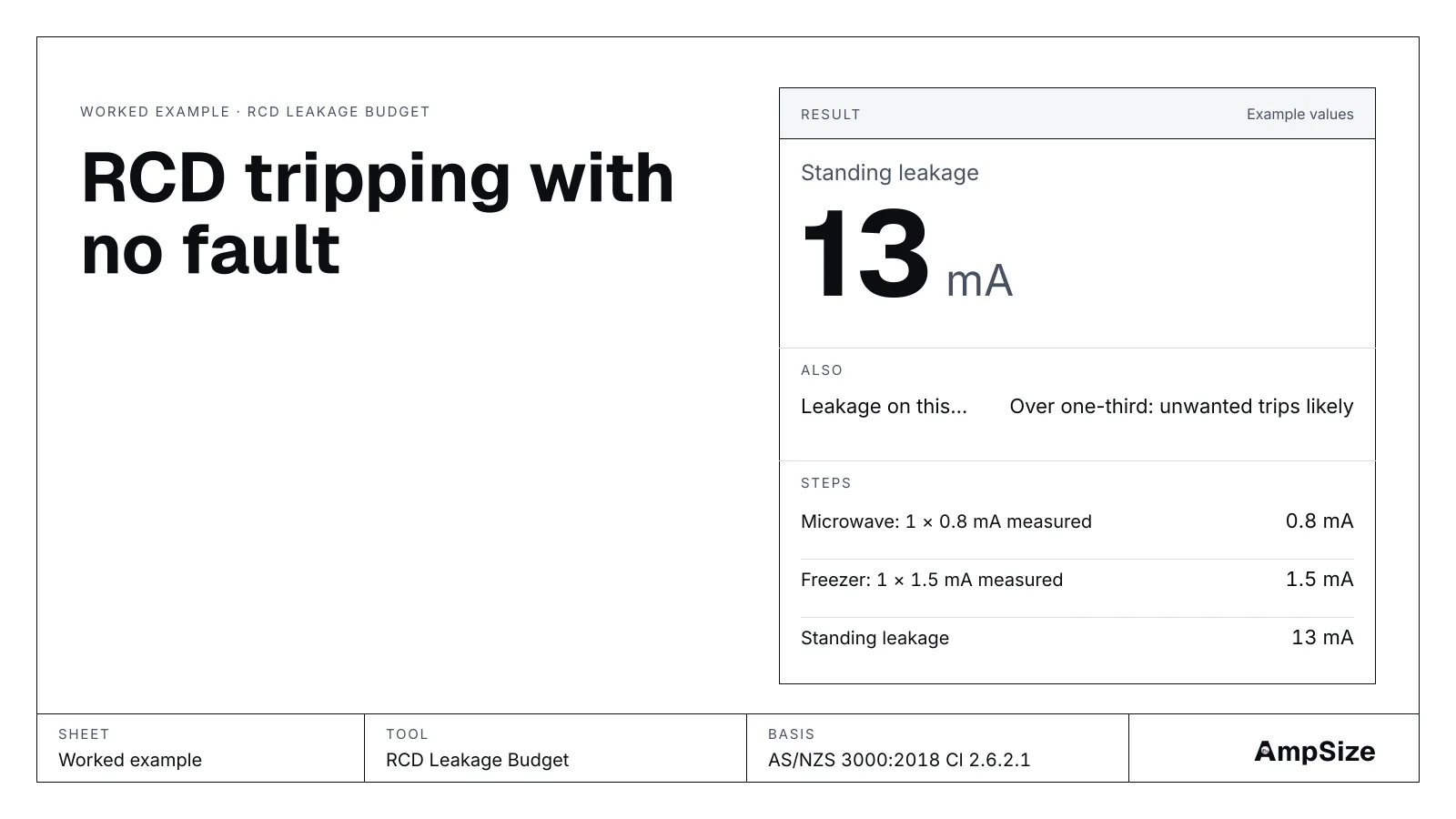
The tool adds the items: 13 mA of standing leakage on one RCD. That is 43.3 % of the 30 mA rating. Open the RCD as it is.
AS/NZS 3000 Cl 2.6.2.1 asks for circuits to be split so normal leakage is unlikely to trip the RCD. Its Note 1 gives two points:
- The leakage should stay within one-third of the rated residual current. On 30 mA that is 10 mA.
- An RCD may operate at any residual current above half its rating. On 30 mA that is above 15 mA.
At 13 mA the RCD is over its budget, but the standing leakage alone is not past the 15 mA point. That is why it trips only some of the time. Little margin is left, and the short surge as an item's filter charges at switch-on, or one more item plugged in, can take it over. The tool adds standing leakage only. It does not model those surges.
Step 3. Split over two RCDs
The tool places the items, largest first, on the fewest RCDs that keep each within 10 mA. It does not split an item. Here it needs 2 RCDs.
It counts the RCDs. It does not choose which circuit goes where. The neat split here is one RCD per circuit, so try each circuit on its own:
| RCD | Items | Standing leakage | Share of 30 mA | Result |
|---|---|---|---|---|
| Before | Both circuits | 13 mA | 43.3 % | Over one-third |
| RCD 1 | Home office | 7.5 mA | 25 % | Within the budget |
| RCD 2 | Kitchen | 5.5 mA | 18.3 % | Within the budget |
Open the home office on its own RCD and the kitchen on its own RCD.
Moving a circuit to a second RCD is a switchboard change. It needs a licensed electrician, and the board needs room for the second device. To plan which circuits share each RCD on the board, use the RCD arrangement tool.
An item with no reading
Say a coffee machine joins the kitchen and nobody has measured it. With no figure, the tool can take the AS/NZS 3760 Table 2.1 in-service limit for its class instead. For a Class I item that is 5 mA: the most it may leak and still pass its test.
The kitchen RCD then carries 10.5 mA, 35 % of its rating, and goes over its budget again. Open the kitchen with the coffee machine at the Class I limit.
The class limit is a worst case. Most items leak far less. Measure it: if the machine reads 0.9 mA, the kitchen carries 6.4 mA and stays within the budget. Open the kitchen with the coffee machine measured.
If one item alone leaks more than the budget, no split helps. Check that item for a fault.
Socket‑outlets
The list holds only what you know of. Anything plugged in later adds to it. Note 2 of the same clause asks you to weigh how many socket‑outlets one RCD of 30 mA or less covers, and what may plug into them. The tool shows that reminder when the RCD protects socket‑outlets.
The result
| Item | Value |
|---|---|
| Standing leakage on the one RCD | 13 mA |
| Budget, one-third of 30 mA | 10 mA |
| The RCD may operate above | 15 mA |
| RCDs to keep each within the budget | 2 |
| Home office RCD | 7.5 mA |
| Kitchen RCD | 5.5 mA |
To check whether a circuit needs an RCD, and which type, use the RCD selection tool. For how often to test and tag the appliances, use the test and tag tool.