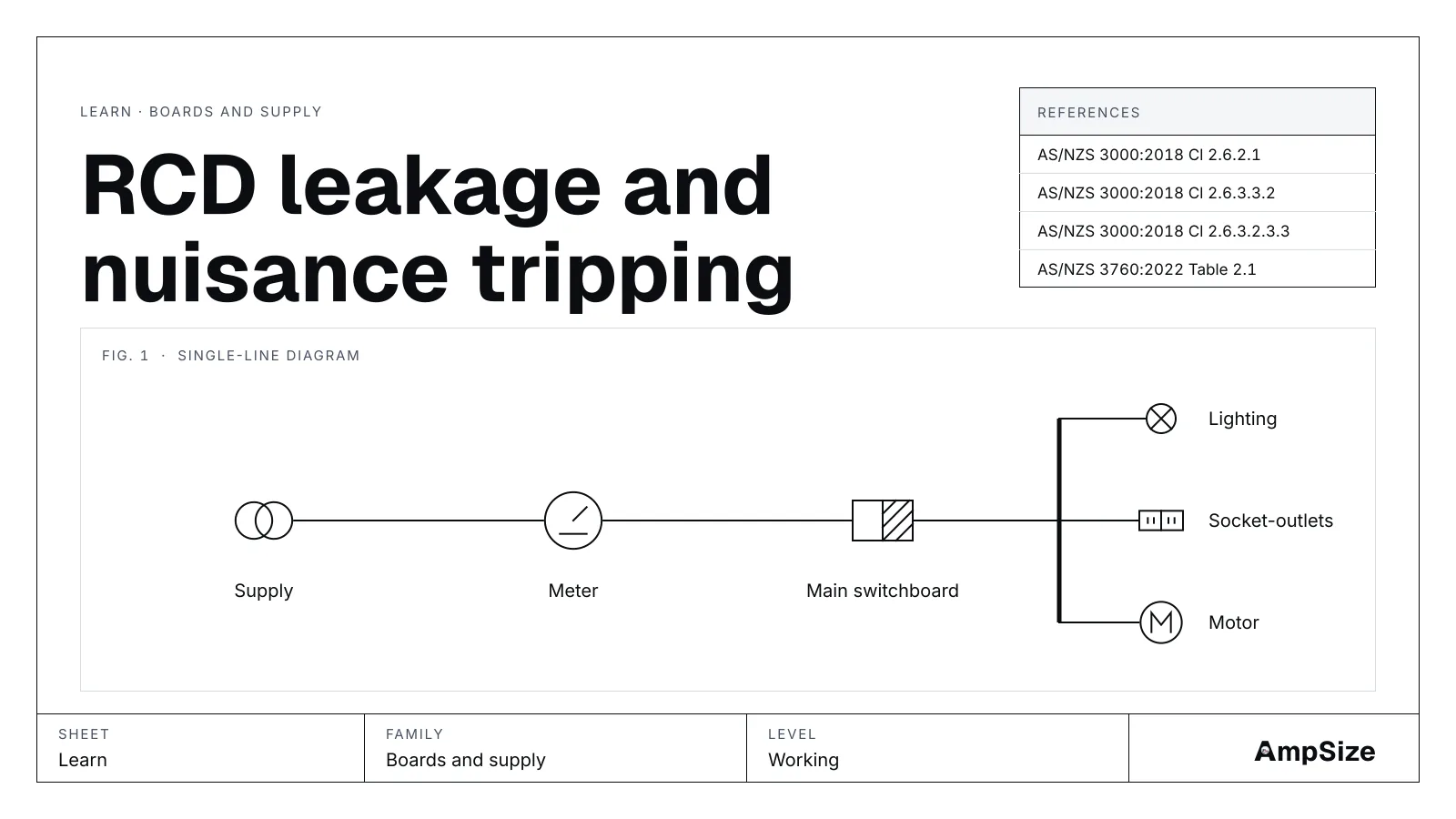
An RCD compares the current going out on the active with the current coming back on the neutral. Any difference has gone to earth, and past a set amount the RCD trips. It cannot tell whether that current went through a person, a fault or an appliance working normally. This page explains the normal part, standing leakage, and how much of it one RCD should carry.
Where standing leakage comes from
Every item leaks a little current to earth while it works. Most of it comes from two places:
- Filters. Computers, heat pumps, chargers and anything with a switch-mode supply or a motor drive have a filter on their input. Its capacitors connect the active and neutral to earth, and a small current flows through them all the time.
- Insulation. No insulation is perfect. Heating elements and long cable runs leak a little, more so when damp or old.
One item's leakage is small. But an RCD sees the sum of everything on its load side. Enough items on one RCD add up to a residual current it may treat as a fault.
The one-third and one-half points
AS/NZS 3000 Cl 2.6.2.1 requires RCDs to be chosen, and circuits split, so the leakage expected in normal use is unlikely to trip the device. That duty is a requirement.
Its Note 1 adds the figures. They sit in a note, so they are guidance and a statement of how an RCD behaves, not a pass mark:
- The standing leakage should not pass one-third of the rated residual current. This is the budget.
- An RCD may operate at any residual current above half its rating. Past that, trips with no fault are to be expected.
At the full rating the RCD is made to trip.
| Rated residual current | Budget, one-third | May operate above |
|---|---|---|
| 30 mA | 10 mA | 15 mA |
| 10 mA | 3.33 mA | 5 mA |
The gap between the budget and the half point is margin. It covers what the sum leaves out: the short surge as filters charge at switch-on, and items plugged in later.
Class limits and measured figures
The best figure for an item is a measured one, from a leakage clamp or an appliance tester, or the maker's figure. Where there is none, the in-service limits of AS/NZS 3760 Table 2.1 give a worst case:
- Class I (earthed) items: 5 mA.
- Class II (double insulated) items: 1 mA.
These are the most an item may leak and still pass its test, not what it usually leaks. Add four Class I kitchen appliances at their limit and the sum is 20 mA, over the half point of a 30 mA RCD. Open four Class I items at the limit.
Measure the same four and you may find far less. In one worked job they read 1.2, 2, 0.8 and 1.5 mA, a sum of 5.5 mA, within the budget. Those are one job's example readings, not typical figures. Open the same four, measured
Use the class limit to see whether a list could be a problem. Use measured figures to decide.
Splitting circuits
When the sum passes the budget, spread the items over more RCDs. A count of the RCDs needed works like packing boxes: take the largest item first, put each on the first RCD with room under its budget, and start a new RCD when none has room. An item cannot be split between RCDs, so the count can be more than the sum divided by the budget suggests.
In practice you move whole circuits, not single items. Check each RCD's share after the move.
If one item on its own leaks more than the budget, no split helps. Check that item's figure, or look for a fault in it.
A 10 mA RCD
A 10 mA RCD has a budget of only 3.33 mA. Four Class II items at their limit leak 4 mA. That is over the budget, though under the 5 mA half point, and they need 2 RCDs. Open four Class II items on a 10 mA RCD.
Socket‑outlets and the country notes
- Socket‑outlets. Note 2 of Cl 2.6.2.1 asks you to weigh how many socket‑outlets one RCD of 30 mA or less covers, and what may plug into them. A list of known items cannot hold what arrives later.
- New Zealand, 10 mA. Where a 10 mA RCD protects socket‑outlets, Cl 2.6.3.3.2 Note 3 asks for fewer of them on one device.
- Australia, high leakage equipment. Outside a home, Cl 2.6.3.2.3.3 Exception 3(ii) lets a final subcircuit for one item that leaks heavily in normal use, such as a variable speed drive, go without an RCD, under its stated conditions. It does not apply in a home.
Add up the items on an RCD with the RCD leakage budget tool. To plan which circuits share each RCD, use the RCD arrangement tool. For when appliances are tested, use the test and tag tool. A worked call-out is in RCD tripping with no fault: add up the leakage.