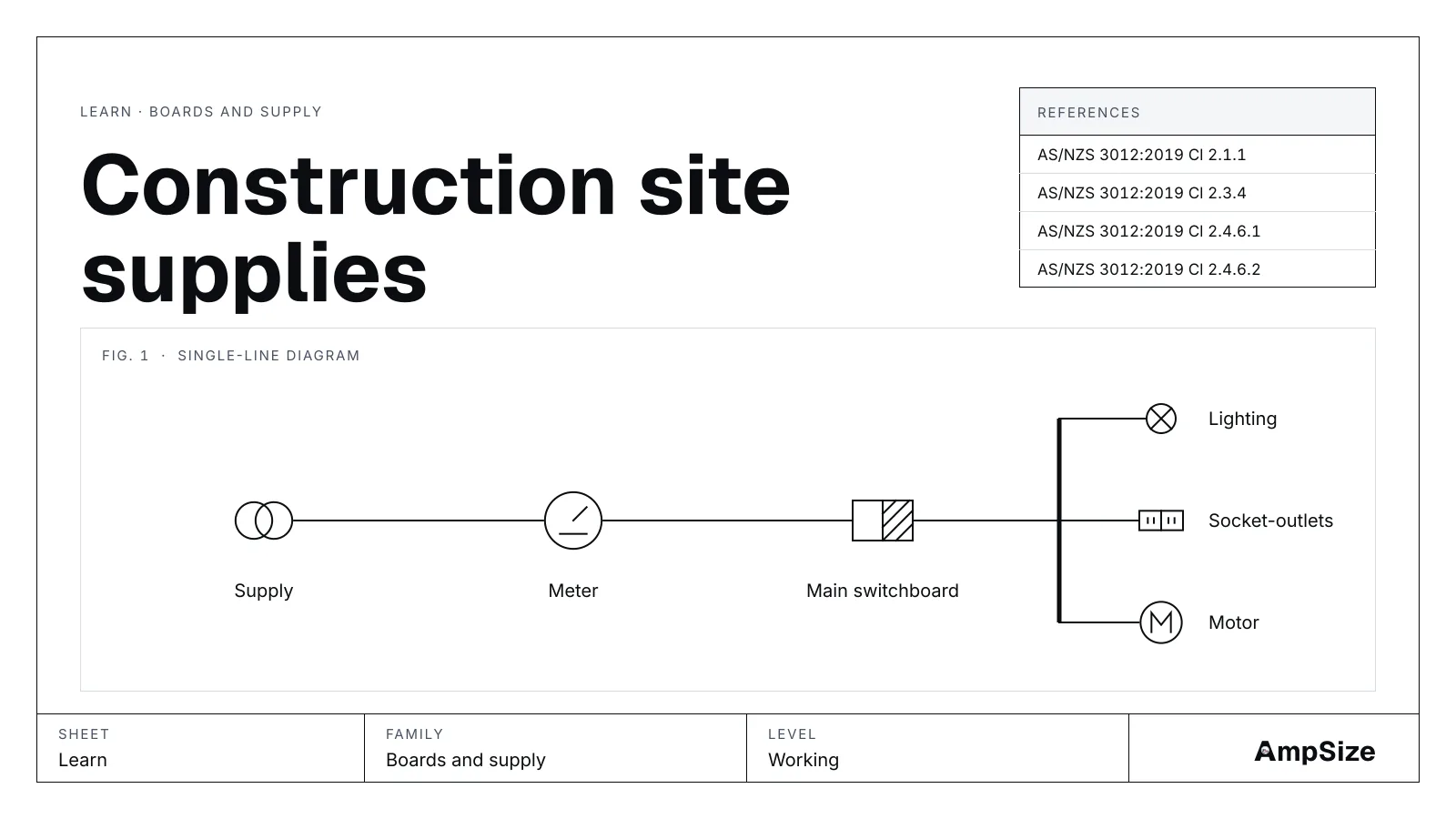
A construction site is hard on electrical equipment. Leads lie in water and under wheels, tools get dropped, and the wiring moves every week as the building grows. AS/NZS 3012 is the standard for the electrical installation on a construction or demolition site. AS/NZS 3000 still applies, and AS/NZS 3012 adds to it. This page sets out what the 2019 edition asks, and which AmpSize tool reads each part.
Where the supply comes from
Cl 2.1.1 allows four supplies for construction wiring:
- the network distributor's main, through a builder's pole or a site main switchboard;
- an existing switchboard in the permanent installation;
- a low voltage generating set, installed to AS/NZS 3010;
- an inverter to AS/NZS 4763.
Equipment then takes its supply from a final sub‑circuit of the construction wiring, from the permanent wiring with its own RCD, or from a stand-alone source such as a small generating set (Cl 2.1.2). The construction site supply tool takes the source and the circuit and reports the clause that applies.
RCDs on every final sub‑circuit
The core rule is Cl 2.4.6.1. Every final sub‑circuit of construction wiring takes an RCD of 30 mA at most, at the board the circuit starts from. The RCD opens the active and the neutral. Spread the lighting circuits across the RCDs where there is more than one of each, so one trip does not put the site in the dark.
The clause has three exceptions in both countries: equipment whose safe mechanical operation needs the supply to stay on, such as a crane or a personnel lift; equipment on SELV or PELV; and equipment on a safety isolating transformer. New Zealand adds a fourth: a 110 V centre-tapped transformer, with plugs and socket‑outlets that fit no other supply. The 2010 edition put that transformer in a note, in both countries.
Work in an existing building can use its socket‑outlets for plug-in tools (Cl 2.4.6.2). The 30 mA RCD then sits at the switchboard, in the socket‑outlet, or in a portable socket‑outlet assembly (a PSOA).
Generators and inverters
Cl 2.4.6.3 sorts generating sets by how they connect:
- A separated winding set with 2 socket‑outlets supplies a separated circuit. It takes one Class I item per set, and Class II items beside it.
- An RCD protected set with up to 2 socket‑outlets puts every outlet behind a 30 mA RCD that opens the active and the neutral. It can supply several items.
- A set with its own switchboard and more than 2 socket‑outlets puts every outlet on a 30 mA RCD.
- A set that feeds a site switchboard is treated as the supply to that board. The board's sub‑mains and final sub‑circuits take their overcurrent devices and RCDs as any other site board does. The set's neutral and earth join the construction wiring at the main switchboard only.
A portable set supplying its own socket‑outlets needs no earth electrode. Cl 2.4.6.4 allows an RCD protected inverter at 30 mA, or an isolated inverter on a separated circuit.
Boards, socket‑outlets and cords
Each socket‑outlet on a site board is 10 A or more (Cl 2.3.4). A note asks for one 15 A or 16 A socket‑outlet where the site needs one, for a welder or a floor sander.
A flexible cord on site has a conductor of 1.0 mm² at least, with its own earth (Cl 2.6.2). Its length is set by Table 1 (Cl 2.6.7). The site cord length tool reads it:
| Rated current | Conductor | General use, single phase | Specific use, single phase |
|---|---|---|---|
| 10 A | 1.5 mm² | 35 m | 20 m |
| 10 A | 2.5 mm² | 60 m | 35 m |
| 15 A or 16 A | 2.5 mm² | 40 m | 25 m |
| 20 A | 4.0 mm² | 50 m | 30 m |
General use is ordinary power tools, at a 5 % drop. Specific use is gear where a motor that fails to start puts someone at risk, such as a swing stage, at a 3 % drop. A three phase, four core cable reaches twice as far, for a balanced load. The drop adds to what the fixed wiring already used.
Joined extension sets share one maximum (Cl 2.6.8(b)). A PSOA has a supply lead of 2 m at most (Cl 2.6.10(b)), and AmpSize counts that lead in the length.
Testing on site
Table 6 sets the intervals. The construction wiring, the boards and fixed equipment take 6 months. Portable equipment, leads, PSOAs, generators and inverters take 3 months. A portable RCD is push-button tested every day it is used, and a fixed RCD every month. The trip time test is every 3 months for a portable RCD and every 12 months for a fixed one. Hire gear is inspected before each hire and tested monthly (Cl 3.2(c)).
The tests themselves follow AS/NZS 3760 (Cl 3.5). The test and tag tool gives those limits. An arc welder built into a generating set has its own insulation resistance minimums in Table 7, which the construction site supply tool reports for that case only.
In New Zealand, the periodic assessment of the site ends with a Record of Assessment in the form of Appendix G (Cl 3.3.2). The Electricity (Safety) Regulations 2010 also amend parts of AS/NZS 3012:2019 for New Zealand use in Schedule 2, including the RCD types a site may use. Read the current version of the regulations.
What AS/NZS 3012 does not cover
A show, a market or a fair is AS/NZS 3002, and the show and carnival tool covers it. A hand-held tool in New Zealand also sits under regs 88 to 89A of the regulations, and the hand-held supply tool lists what they name.
How the 2019 edition differs from 2010
The figures AmpSize reads did not change. The clause numbers did: Table 3 is now Table 6, Table 2 is now Table 7, and Section 3 renumbers: the RCD tests of Cl 3.5 are now Cl 3.4. The generator clause was rebuilt, AS 2790 is no longer named, and the separated winding set's limit is now one Class I item per set.
Worked through
The builder's pole guide works one pole for a house build through the supply, the RCDs, a 45 m lead and the test intervals. On a plan, select a run from a builder's pole and the Run menu offers the cord length check. The Site builder draws a temporary board as the builder's pole.
This page is a design aid. Verify every value against the current edition of the standard.
See also: Builder's pole: supply, RCDs and cord lengths, RCD types and where they are required and Homeowner shed supply voltage drop over 60 m.