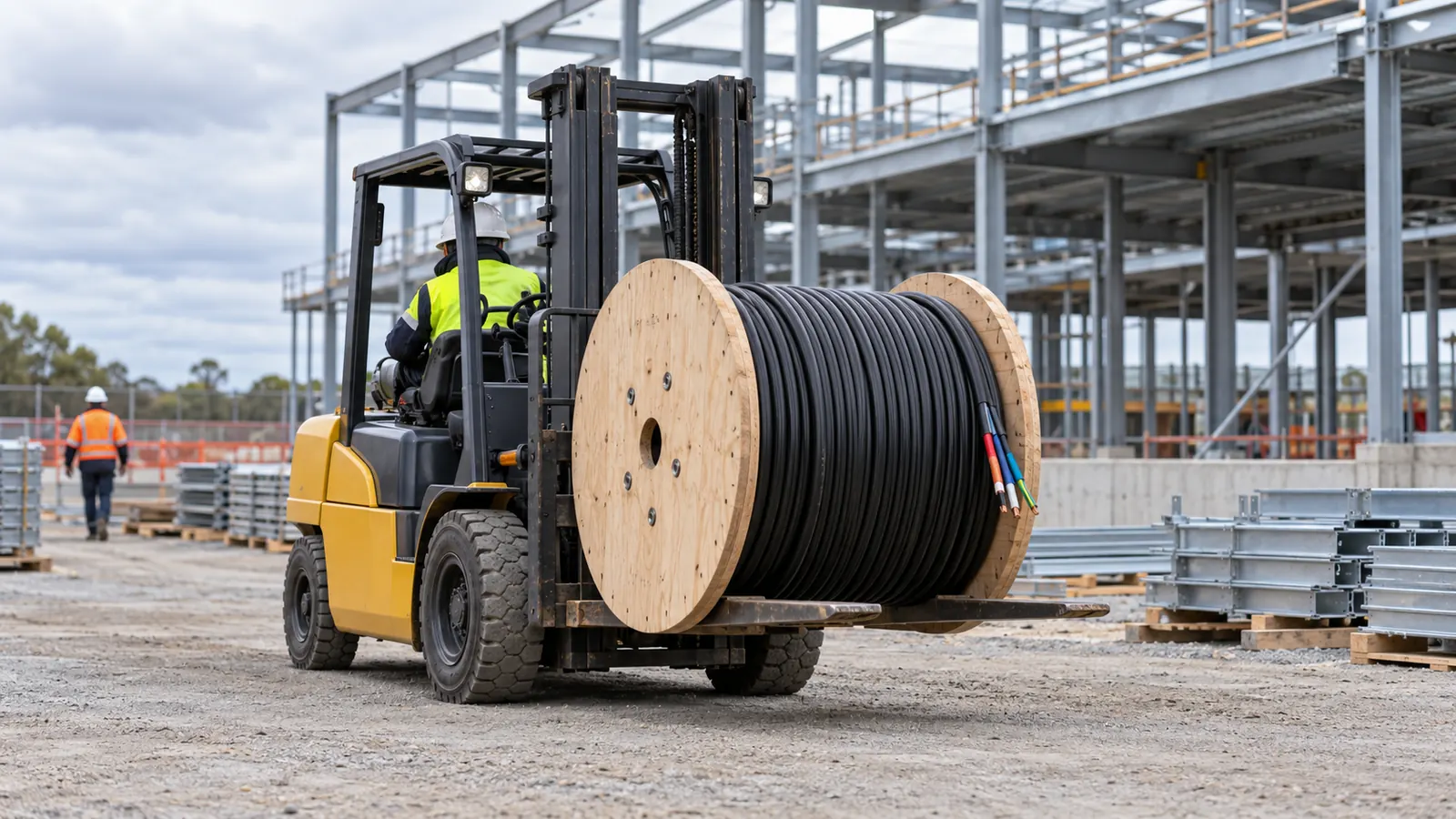
A tender asks for a 160 A submain to a tenancy board 80 m away. The cable schedule says 70 mm² copper XLPE. The estimator needs one check before the price goes out: the voltage drop over the run.
The question
The tender needs the percentage drop that 160 A produces over 80 m on 70 mm² copper. It also needs the route length the 5 % budget allows. A full cable size run comes later. At price stage the drop is the check that changes the cable, and the cable is the cost.
The inputs
- Phases: 3, line voltage 400 V
- Current: 160 A
- Route length: 80 m
- Power factor: 0.9
- Conductor: 70 mm² copper, XLPE insulated, one cable
- Limit: 5 %
The route length is the cable length, not the straight line on the drawing. Add the risers, the drops and the run around the plant room. A tender that prices the straight line runs short on site.
The clause and the tables
Cl 3.6.2 of AS/NZS 3000:2018 sets the drop allowed from the point of supply onward. The 5 % in the example is that limit. Cl 4.5 of AS/NZS 3008.1.2:2017 sets the method that turns conductor data into one millivolt figure. Tables 30 to 35 hold the resistance and the reactance.
The steps
The tool reads the conductor data first.
- Resistance: 0.342 Ω/km
- Reactance: 0.074 Ω/km
It combines those at a power factor of 0.9 and gets 0.589 mV/A·m.
Then the arithmetic. 0.589 mV multiplied by 160 A and by 80 m gives 7.54 V. Against 400 V that is 1.89 %.
The result
1.89 % against a 5 % limit. The run passes, and the tool reports no warnings.
The maximum length at the limit is 212.2 m. The 80 m route uses about a third of the budget. That margin is what an estimator wants at price stage. The route grows during construction, and the drop grows with it.
Three points matter when the figure goes into a price.
The budget is shared. The 5 % covers the whole path from the point of supply. Consumer mains already used part of it before this submain starts. Final subcircuits use more after it ends. Price the submain against its share, not against the full 5 %. Set the limit in the tool to that share and read the maximum length again.
Reactance is now visible. At 70 mm² the reactance of 0.074 Ω/km is a real fraction of the 0.342 Ω/km resistance. It was negligible on small conductors. This is why a large cable does not improve as fast as its area suggests. Going up one size no longer halves the drop.
The drop check is not the size check. 1.89 % says nothing about current carrying capacity, derating on a tray, the device rating or the fault withstand. Run the cable size tool before the design is fixed. Use this page to decide whether the scheduled cable is worth pricing at all.
Power factor moves the result. At 0.9 the reactance contributes. At unity it almost disappears. Take the power factor from the load schedule rather than assuming it.
This page is a design aid. Verify every value against the current edition of the standard.
See also: Voltage drop with the mV/A·m method, AS/NZS 3000 Clause 3.6.2: voltage drop limit and Voltage drop basics.