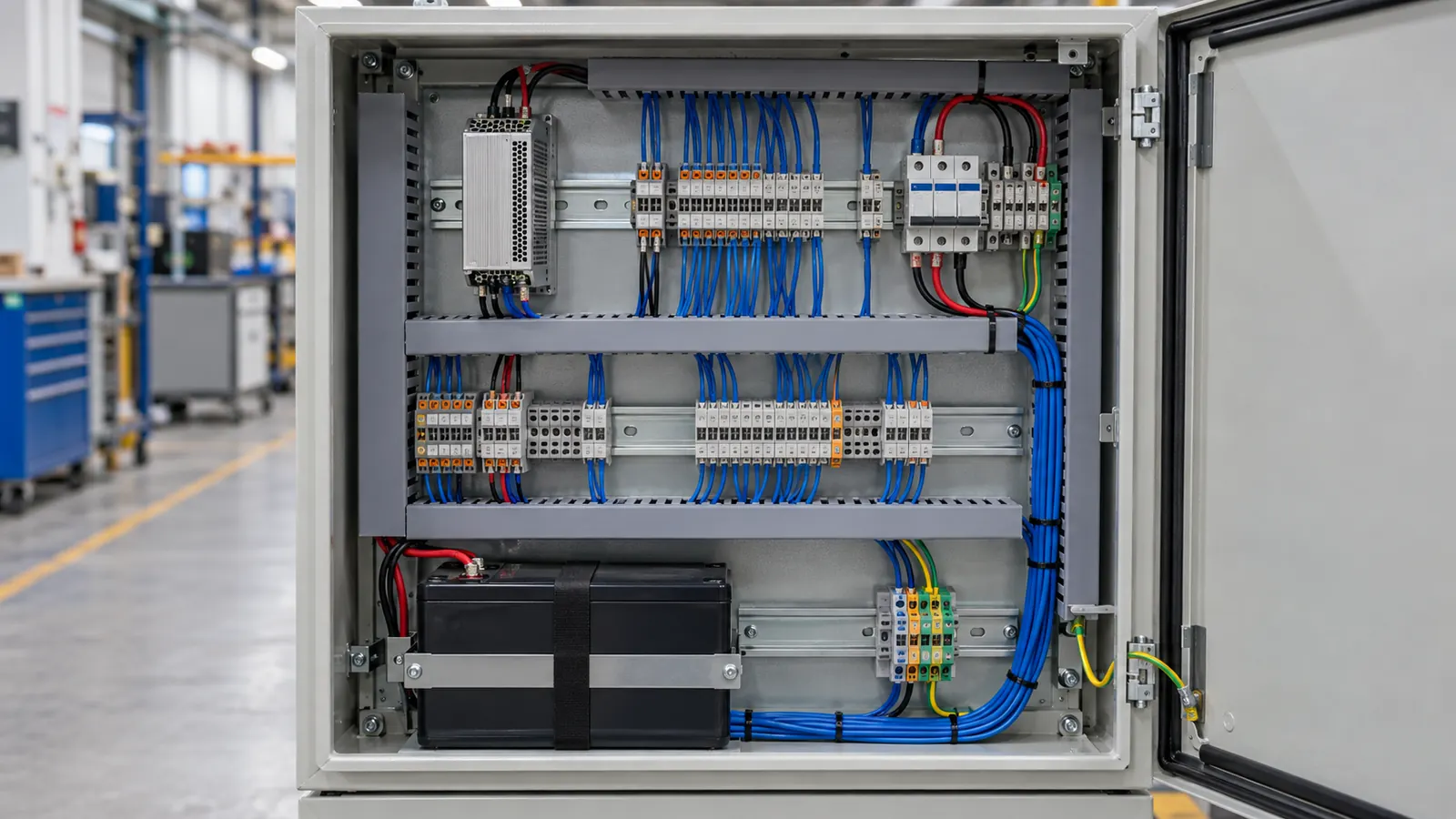
A control panel loses its supply. The PLC, the I/O and the field instruments have to keep running. They run until the supply returns or the plant reaches a safe state. The question is the size of the battery bank in ampere hours. This page sizes one 24 V DC panel for a full day.
The inputs
- Load 1: 60 W for 24 h, the PLC rack and the I/O cards
- Load 2: 20 W for 24 h, the field instruments and the interposing relays
- System voltage: 24 V DC
- Depth of discharge: 0.8
- Inverter efficiency: 1
- Autonomy: 1 day
Two entries carry the intent. The depth of discharge of 0.8 suits a cell chemistry rated for deep cycling. Set it to 0.5 for a flooded lead acid bank and the same panel needs 160 Ah.
The inverter efficiency is set to 1 because there is no inverter. The PLC power supply, the I/O and the instruments all sit on the 24 V DC bus. Nothing converts to AC, so no conversion loss applies. Leaving the default of 0.9 in place would add a loss that this panel never takes.
The clause
AS/NZS 3000:2018 Cl 7.5.7 covers battery installations and the parts of an installation that a battery supplies. The sizing itself is a direct energy calculation, so it cites no table.
The steps
The tool multiplies watts by hours for each load and adds the results. It divides that energy by the system voltage to get the charge drawn in a day. It multiplies by the days of autonomy and divides by the depth of discharge to get the bank capacity.
- Energy per day: 1,920 Wh
- Charge per day: 80 Ah
- Required capacity: 100 Ah
The result
The panel needs a 100 Ah bank at 24 V DC for one day of ride-through. In practice that is two 12 V blocks in series, or a lithium iron phosphate unit built for 24 V.
The 80 Ah drawn per day and the 100 Ah of installed capacity differ. The depth of discharge is the whole gap. The bank never runs to empty. Sizing to 80 Ah would take the cells to zero on the first full outage and shorten the life of the bank.
Four things to watch
Count continuous loads at their peak. A PLC rack draws its rated figure all day. A solenoid bank, a panel fan or a beacon does not. Enter each load at the hours it actually runs, or the bank grows for no reason.
Add the alarm and shutdown loads. An outage often energises a valve, a horn or a modem. Those sit idle in normal service. Add them as separate rows, with the hours they run during the outage.
Set the autonomy to the site. One day suits a plant with staff on site and a generator on standby. A remote pump station with a four hour drive to it needs more. Change the autonomy days and the capacity scales with it.
Apply a temperature derating. The temperature factor defaults to 1. A panel in an outdoor kiosk or an unheated plant room sits below the cell rating temperature. Capacity falls with it. Use the derating the cell maker gives for the site temperature.
The tool does not size the DC cables, the charger or the protective devices between the bank and the panel. Use the cable size tool for the DC run from the bank to the bus.
This page is a design aid. Verify every value against the current edition of the standard.
See also: 24 V DC voltage drop on an instrument loop, Off-grid battery bank autonomy at 48 V and Control panels and PLC wiring.