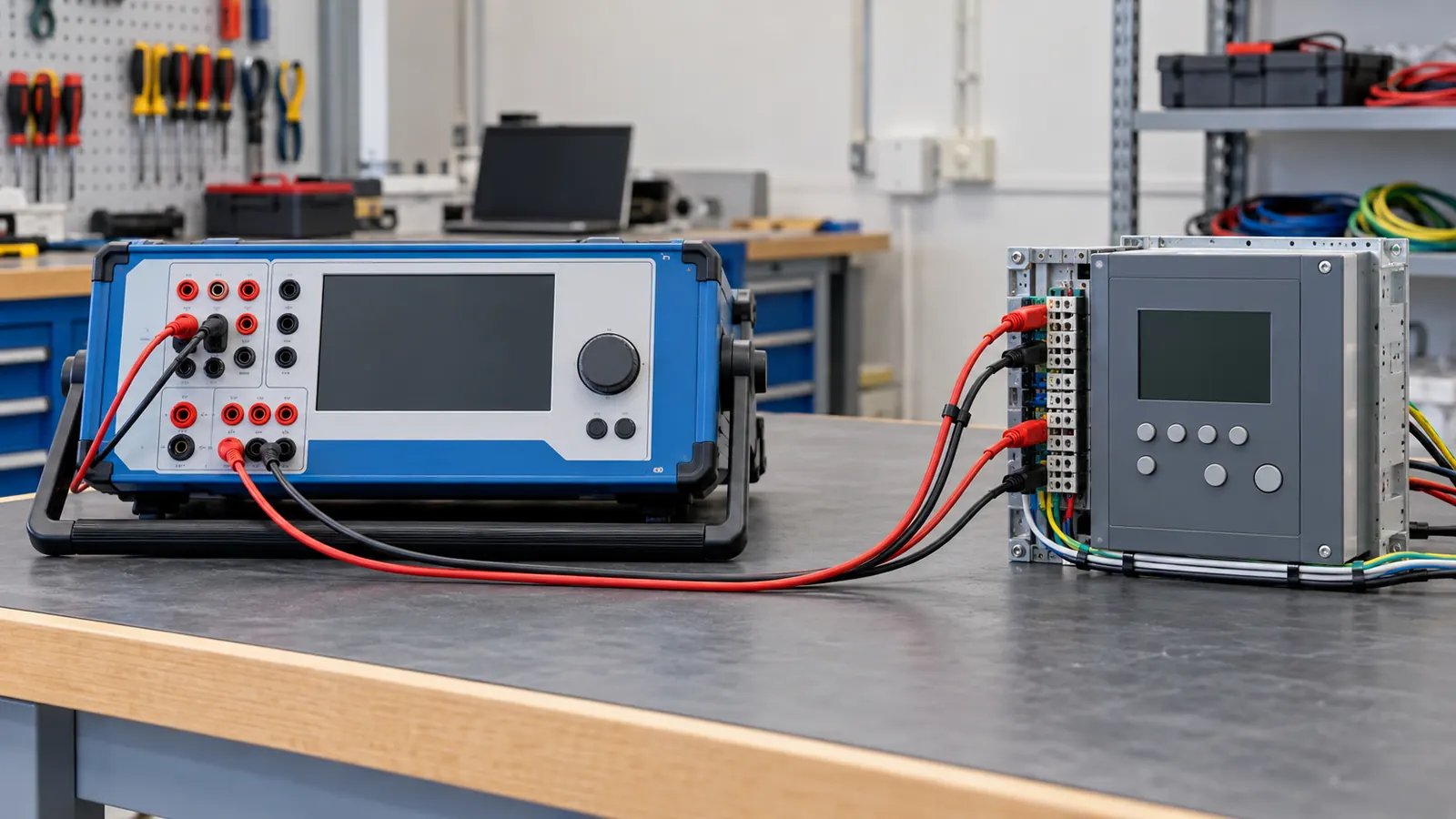
An inverse time overcurrent relay trips faster as the fault current rises. The shape of that relationship comes from a standard, not from the relay maker.
The question
Two relays sit in series on the same feeder. Both run a standard inverse characteristic. Does the downstream relay clear a 2.5 kA fault before the upstream relay moves?
The inputs
- Fault current: 2500 A
- Downstream relay: standard inverse, pickup 100 A, time multiplier 0.1
- Upstream relay: standard inverse, pickup 250 A, time multiplier 0.25
- No instantaneous element on either relay
The clause and the curve sets
Cl 5.2 of IEC 60255-151:2009 defines the inverse time characteristic. Three quantities set the trip time. The first is the ratio of fault current to pickup current. The second is a pair of curve constants. The third is the time multiplier. Annex A of the same document lists the constants for each named curve.
Four IEC curves carry those constants: standard inverse, very inverse, extremely inverse and long time inverse. Each pair of constants bends the curve differently. A steeper curve drops its trip time faster as current rises, which suits a feeder close to a strong source.
IEEE C37.112-1996 defines a separate set: moderately inverse, very inverse and extremely inverse. That equation carries an extra term. An IEEE curve and an IEC curve of the same name therefore give different trip times on the same settings.
The IDMT tool reads both sets. It plots every relay on one axis and reads each trip time at the fault current entered.
The steps
The tool takes each relay in turn.
It divides the fault current by the pickup current. For the downstream relay, 2500 A over 100 A gives a multiple of 25. For the upstream relay, 2500 A over 250 A gives a multiple of 10.
It puts that multiple through the Cl 5.2 equation with the standard inverse constants. It then scales the answer by the time multiplier.
At 2500 A the downstream relay trips in 0.21 s. The upstream relay trips in 0.74 s.
The tool subtracts the two and reports the grading margin: 0.53 s.
The result
The pair grades. The downstream relay clears the fault about half a second before the upstream relay reaches its own trip point. The tool flags a margin below 0.3 s as a warning, and 0.53 s sits clear of that line.
Three points decide a grading study. The multiple of pickup drives the position on the curve. A higher pickup therefore pushes a relay to a slower part of its own characteristic. The time multiplier scales the whole curve without changing its shape. Mixing an IEC curve with an IEEE curve changes the spacing at every current, so a margin can close up higher on the curves.
This check covers one current. Run the study again at the minimum fault current and at the maximum. The margin moves with the current, and a pair that grades here can fail there.
This page is a design aid. Verify every value against the current edition of the standard.
See also: IDMT curve grading for a 100 A feeder, Arc flash incident energy at a 400 V switchboard and Arc flash basics.