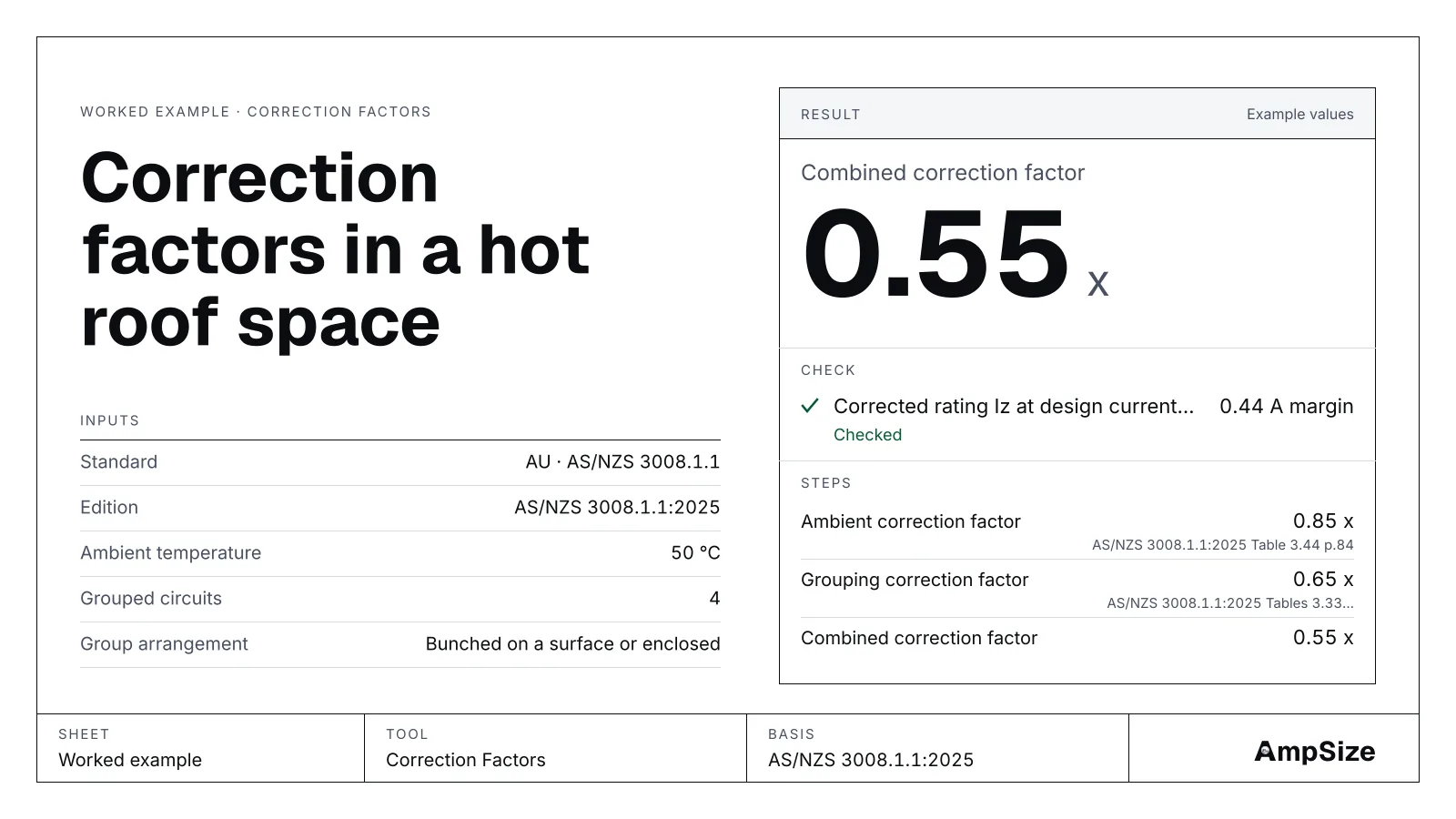
A roof space on a hot Australian afternoon can pass 50 °C under the iron. Four power circuits share one route through it. Two factors cut the rating: the heat and the grouping. This guide derates one cable size on AS/NZS 3008.1.1:2025 and then runs the 2017 edition.
The inputs
- Australia, edition 2025.
- Four single‑phase circuits, bunched on a surface in the roof space.
- Design current 20 A per circuit.
- Copper, PVC insulated, multicore.
- Air at 50 °C.
AS/NZS 3000:2018 Cl 3.4 sets the check. The corrected rating Iz must meet the design current.
The factors
The 2025 edition rates cables at 40 °C. Table 3.44 gives the ambient factor for 50 °C. Tables 3.33, 3.36 and 3.38 give the grouping factor.
Open the run for 6 mm². The ambient factor is 0.85. The grouping factor is 0.65. The combined factor is 0.55.
The cable needs a tabulated 36.2 A. Table 3.18 rates 6 mm² at 37 A. The corrected rating Iz is 20.44 A, which passes by 0.44 A.
The smaller sizes
4 mm² rates 29 A and corrects to 16.02 A. It fails. 2.5 mm² rates 22 A and corrects to 12.16 A. It fails.
A 0.44 A margin leaves little room. 10 mm² corrects to 28.18 A, a margin of 8.18 A.
What changes the answer
A single layer on the ceiling reads a different grouping table. Change the arrangement to single layer, ceiling, touching. The grouping factor rises to 0.68 and Iz to 21.39 A.
Fewer circuits help more. With two circuits the grouping factor is 0.8 and Iz is 25.16 A. Cooler air helps too. At 40 °C the ambient factor is 1. Four circuits still fail 4 mm², with an Iz of 18.85 A.
The same route on 2017
On the 2017 edition the ambient factor at 50 °C is 0.82. The combined factor is 0.53. The tool needs 37.52 A tabulated. 6 mm² corrects to 19.72 A and fails.
The same circuits pass on one edition and fail on the other. A design near its limit should run both editions before you reuse an older calculation.
Reading the hottest point
The tool takes one ambient value for the whole route. A roof space is not uniform. The air near the ridge is hotter than the air near the eaves. Enter the hottest point on the route, because the cable is only as good as its worst metre.
A route can also leave the roof space. Part of it may run through a wall, where the air is cooler. Split the circuit into sections if the run is long. Size on the section that governs.
Cutting the heat and the bunch
Three changes lift the corrected rating without a larger cable. Lay the circuits in a single layer. Split them across two routes. Keep the cable below the insulation, where the air is cooler. The tool shows the first two directly, as the single layer and two circuit cases above.
Roof insulation also traps heat around a cable laid on top of it. The tool does not model that effect. Treat a cable buried in insulation as a separate check.
The result
| Case | Combined factor | 6 mm² Iz | Result |
|---|---|---|---|
| 2025, 50 °C, four bunched | 0.55 | 20.44 A | Passes |
| 2025, 50 °C, single layer | 0.58 | 21.39 A | Passes |
| 2025, 50 °C, two circuits | 0.68 | 25.16 A | Passes |
| 2017, 50 °C, four bunched | 0.53 | 19.72 A | Fails |
6 mm² passes on 2025 with 0.44 A to spare. 10 mm² has a margin of 8.18 A. Try it with these inputs.
This page is a design aid. Verify every value against the current edition of the standard.
See also: Three circuits in a hot ceiling: correction factor, Correction factors in the 2017 and 2025 editions and AS/NZS 3008 derating Tables 22 to 29.