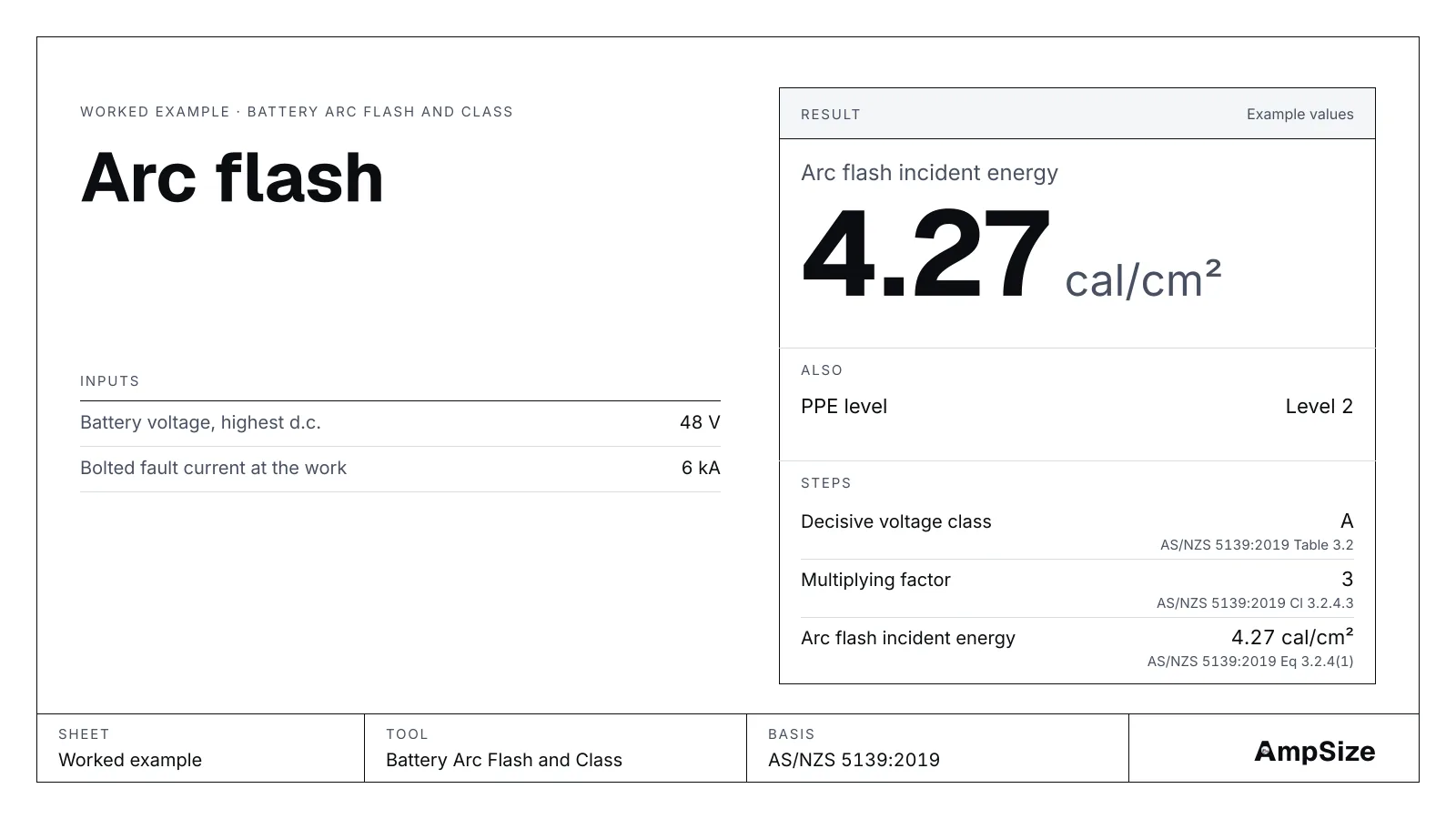
AS/NZS 5139 asks for a battery system to be classed before it goes in. Its chemistry sets the hazards, its voltage sets the decisive voltage class, and its fault current sets the arc flash energy. That energy then decides the PPE level and where the battery may go in a home. This guide works one solar job with the battery arc flash and class tool. The method is explained in Battery classes and arc flash in AS/NZS 5139.
The job
- A lithium ion home battery at 48 V d.c., in its own cabinet, in a garage attached to the house.
- The maker gives a bolted fault current of 6 kA at the battery terminals.
- No inter-string fuses. The only protection is the d.c. breaker beside the inverter.
Step 1. The class
Lithium ion carries the electrical, energy, mechanical, explosive gas and toxic fume hazards of Table 3.1, and is fire hazard level 1. At 48 V d.c. the battery is DVC-A by Table 3.2.
Step 2. The arc flash energy
The work is on the battery terminals, on the battery side of the breaker. Cl 3.2.4.2.3 then takes the arc to last 2 s. The other inputs are the standard's:
| Input | Value | Clause |
|---|---|---|
| Arcing current, half the bolted fault current | 3 kA | Eq 3.2.4(2) |
| Working distance, at most | 45 cm | Cl 3.2.4.2.2 |
| Multiplying factor in an enclosure, at least | 3 | Cl 3.2.4.3 |
| Arcing time | 2 s | Cl 3.2.4.2.3 |
Equation 3.2.4(1) gives 4.267 cal/cm², shown as 4.27 cal/cm². That is PPE Level 2 by Table 3.3, and a Moderate consequence by Table 6.1. The arc flash boundary, where the energy falls to the boundary level, is 849 mm (Equation F.4). Open the 48 V battery.
Step 3. The home limit
The battery is in a home, and its energy is above the limit in Cl 6.3.2.3. The tool warns that it needs a dedicated battery room or enclosure not attached to a building with habitable rooms, or fire hazard level 1, and that it may not go inside or against such a building. Check that clause for this garage before you fix the location.
| Energy in a home | What the tool flags by Cl 6.3.2.3 |
|---|---|
| 4 cal/cm² or less | Nothing |
| Above 4 cal/cm² | A dedicated room or enclosure, or fire hazard level 1 |
| 40 cal/cm² or more | A fail: the energy must be below 40 cal/cm² |
The tool also notes that inter-string protection can bring the energy below the limit.
Step 4. Fit inter-string fuses
Fit fuses between the strings, sized so they clear the arc in 0.1 s. Read that time off the fuse maker's curve. The tables in Appendix F of the standard take 0.1 s where inter-string protection is fitted, and 2 s where it is not.
With the arc cut to 0.1 s, the energy falls to 0.21 cal/cm². That is PPE Level 1, an Insignificant consequence, and a boundary of 190 mm. The home warning goes. Open the battery with inter-string fuses.
| Arcing time | Energy | PPE level | Consequence | Boundary |
|---|---|---|---|---|
| 2 s, no inter-string fuses | 4.27 cal/cm² | Level 2 | Moderate | 849 mm |
| 0.1 s, inter-string fuses | 0.21 cal/cm² | Level 1 | Insignificant | 190 mm |
The fault current and the voltage are the same. Only the time changed. The energy is in proportion to the arcing time, so the clearing time of the protection matters most.
A high voltage battery
Some home batteries stack modules to a high d.c. voltage. Take a pre-assembled lithium battery at 204.8 V with 9 kA at its terminals, made to the industry Best Practice Guide. Table 3.1 Note 1 then gives it no fire hazard level. Keep the maker's evidence for that.
At 204.8 V d.c. it is DVC-C. Table 3.2 Note 2 makes a DVC-B or DVC-C battery system a low voltage installation under AS/NZS 3000. The arcing current is 4.5 kA, and at 2 s the energy is 27.31 cal/cm²: PPE Level 4, a Major consequence, and a boundary of 2147 mm. Open the 204.8 V battery.
With inter-string fuses at 0.1 s it falls to 1.36 cal/cm², PPE Level 1. Open the 204.8 V battery at 0.1 s.
The result
| Item | 48 V, no fuses | 48 V, fuses at 0.1 s |
|---|---|---|
| Decisive voltage class | DVC-A | DVC-A |
| Fire hazard level | Level 1 | Level 1 |
| Arc flash incident energy | 4.27 cal/cm² | 0.21 cal/cm² |
| PPE level | Level 2 | Level 1 |
| Consequence level | Moderate | Insignificant |
| Arc flash boundary | 849 mm | 190 mm |
The tool reads AS/NZS 5139:2019 as published. Amendment 1 (2025) is not checked, so confirm any change it makes before you rely on a figure.
To size the battery itself, use the home battery tool, or follow Solar battery size for a family home. For the cable from the battery to the inverter, use the d.c. cable size calculator. Arc flash on an a.c. switchboard uses a different model, in the arc flash calculator.